
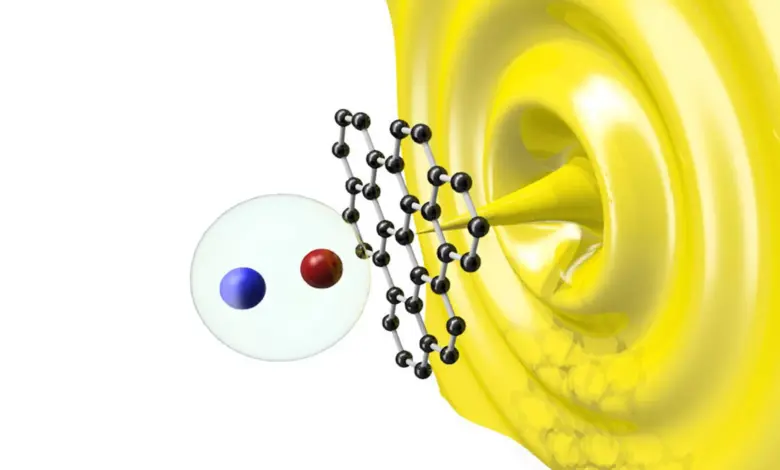
Positronium Exhibits Wave Behavior
Quantum mechanics dictates that matter exhibits wave-like properties, a phenomenon known as wave-particle duality, famously demonstrated by the double-slit experiment using electrons. While this effect has been confirmed in neutrons, helium atoms, and large molecules, it had never been directly observed in positronium. Positronium is a unique, short-lived two-body system composed of an electron and its antimatter counterpart, the positron, bound together and orbiting a shared center of mass. Because both constituents have equal mass, positronium represents the simplest possible atom in this regard.
A team from Tokyo University of Science, led by Professor Yasuyuki Nagashima, along with Associate Professor Yugo Nagata and Dr. Riki Mikami, has now successfully demonstrated matter-wave diffraction in a beam of positronium. The researchers produced a highly controlled positronium beam with the necessary energy range and coherence to generate clear interference effects. Their results, published in Nature Communications, provide direct evidence of quantum interference in this exotic system.
“Positronium is the simplest atom composed of equal-mass constituents, and until it self-annihilates, it behaves as a neutral atom in a vacuum,” Professor Nagashima stated. “Now, for the first time, we have observed quantum interference of a positronium beam, which can pave the way for new research in fundamental physics using positronium.” The technical challenge lay in beam creation; the team first generated negatively charged positronium ions and then used a precisely timed laser pulse to remove an extra electron, resulting in a coherent neutral beam capable of exhibiting diffraction patterns.
Accelerating Antihydrogen Production
Independent of the wave behavior study, the ALPHA experiment at CERN’s Antimatter Factory has reported a significant advancement in the production of antihydrogen, the simplest form of atomic antimatter consisting of a positron orbiting an antiproton. In a paper published in Nature Communications, researchers detailed a new cooling technique that allows them to produce over 15,000 antihydrogen atoms in a matter of hours, an eightfold increase in production rate compared to previous methods.
The creation of antihydrogen requires trapping clouds of antiprotons and positrons separately, cooling them, and merging them. The bottleneck has often been the temperature of the positrons. Using a technique called sympathetic cooling, the ALPHA team introduced a cloud of laser-cooled beryllium ions into the Penning trap containing the positrons. This interaction allowed the positron cloud to lose energy, reaching a temperature of approximately -266 °C. This lower temperature significantly increases the likelihood of efficient antihydrogen formation when mixed with antiprotons.
Jeffrey Hangst, spokesperson for the ALPHA experiment, noted that these production numbers “would have been considered science fiction 10 years ago.” The efficiency gain is substantial: it previously took researchers 10 weeks to accumulate the roughly 16,000 atoms required to measure the spectral structure of antihydrogen with high precision. With the new method, the team can now accumulate sufficient atoms overnight to perform spectral measurements the following day. During the 2023–24 experimental runs, this approach yielded over two million antihydrogen atoms, enabling more detailed investigations into atomic antimatter and systematic uncertainties.
Transporting Antimatter
While production and observation capabilities have improved, logistical constraints have historically limited precision measurements. The BASE experiment at CERN faced a specific challenge: the infrastructure of CERN’s antimatter factory introduces magnetic field fluctuations that, while negligible in most contexts, interfere with the ultra-precise measurements required to compare antiprotons and protons. To resolve this, the BASE team developed BASE-STEP, a transportable device designed to move antimatter to quieter laboratory environments.
In a recent milestone, researchers successfully transported a compact trapping system loaded with 92 antiprotons across CERN’s main campus. The apparatus, weighing roughly one metric tonne, is built around a cryogenic Penning trap that uses magnetic and electric fields to confine charged particles in a near-perfect vacuum. The system includes a superconducting magnet, liquid helium cooling, onboard power reserves, and a vibration-resistant housing. The team disconnected the apparatus from its host facility, transported it by truck, and resumed operations without losing the particles.
Christian Smorra, leader of the BASE-STEP project, explained that while the feasibility was validated with protons last year, the successful transport of antiprotons is a “huge leap forward.” The ultimate aim is to deliver antiprotons created at CERN to dedicated precision laboratories at CERN, Heinrich Heine University Düsseldorf, Leibniz University Hannover, and potentially other institutions. This capability is essential for detecting minute asymmetries in antiproton properties, which could shed light on the matter-antimatter imbalance in the universe—a discrepancy that contradicts standard Big Bang models predicting equal quantities of both.
These three advancements—observing quantum waves in positronium, scaling up antihydrogen production, and enabling the transport of trapped antiprotons—collectively lower the barriers to high-precision tests of fundamental physics. They provide the necessary tools and samples to explore whether antimatter behaves identically to matter in all respects, including under the influence of gravity and in the context of quantum interference.