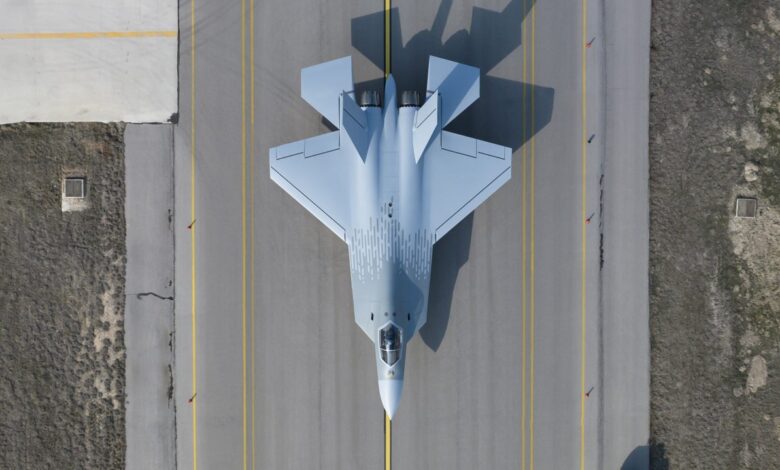
The aircraft, designated P1, is distinct from the initial P0 prototype that first flew in February 2024. While P0 served as a demonstrator to prove the viability of the twin-engine, stealthy airframe, P1 is built to the configuration intended for serial production. According to TUSAŞ General Manager Mehmet Demiroğlu, P1 has successfully undergone ground and taxi tests that verify critical systems including engines, hydraulics, flight controls, avionics, landing gear, and brakes. These tests are the final gate before the maiden flight of the production-representative airframe.
Visual inspections of P1 reveal subtle but significant refinements compared to the earlier demonstrator. The new prototype features revised control surfaces, modified engine intake geometries, and a cleaner external finish, all designed to enhance stealth characteristics and aerodynamic efficiency. However, the aircraft retains non-stealthy exhaust nozzles for its twin General Electric F110-GE-129 turbofan engines. This reliance on American propulsion remains the program’s most significant short-term dependency, serving as a bridge until Turkey’s indigenous engine program matures.
The propulsion strategy is central to understanding the KAAN’s operational timeline. The F110-GE-129 is the same engine family powering late-model F-16s and the F-15EX, ensuring that TUSAŞ has access to a proven, high-performance powerplant for flight testing. In June 2026, the US State Department notified Congress of a proposed sale of approximately 80 F110 engines to TUSAŞ for more than $700 million. The export authorization process was cleared by the US Congress on 9 July 2026. Demiroğlu confirmed at the Farnborough International Airshow in July that TUSAŞ currently holds 10 engines in Ankara for prototype and flight-test work, while the 80 additional units are secured for initial serial production. This procurement ensures that engine availability will not bottleneck airframe deliveries, which are scheduled to begin in 2028.
The transition to indigenous propulsion is a strategic long-term objective. TUSAŞ has announced plans to integrate the domestically developed TF35000 turbojet into the KAAN from Block 30 onwards, with deliveries of this variant targeted for 2033. The TF35000 is sized for the 35,000-pound-force class (approximately 156 kN), matching the thrust requirements of the airframe. By relying on the F110 for the initial blocks, Ankara buys time to develop the TF35000 without interrupting the production ramp-up. This dual-track approach mitigates the technical risks associated with a new engine while preserving the timeline for the Turkish Air Force’s next-generation requirements.
Operationally, the program is accelerating toward its second airframe. The second prototype, P2, has completed slow taxi tests and is expected to fly before the end of 2026. Demiroğlu stated that both P1 and P2 are projected to be flying alongside each other by year-end, allowing for comparative data collection and accelerated envelope expansion. This parallel testing strategy is essential for meeting the 2028 delivery deadline for the first batch of 20 Block 10 aircraft, a contract signed by the Presidency of Defense Industries in May 2026.
The industrial base supporting these deliveries is undergoing a major restructuring. TUSAŞ is moving up to 70% of parts and assembly work to subcontractors, a necessary step to achieve the production rates demanded by the Turkish Air Force and potential export customers. This shift from a centralized manufacturing model to a distributed supply chain reflects the complexities modern combat aircraft present and aims to reduce lead times and costs. The strategy is already yielding international interest: Indonesia signed for 48 aircraft in July 2025, and Egypt has been reported to be in discussions regarding joining the program.
For the Turkish Air Force, which was removed from the F-35 program in 2019, the KAAN is the only viable route to a home-built fifth-generation fighter. The coming weeks will determine whether the technical promises of the production prototype hold up under flight conditions. While the strategic significance of a sovereign stealth capability is clear, the immediate focus remains on the rigor of the flight-test campaign. Success in the next few months will solidify the 2028 delivery schedule and validate the industrial strategy that underpins Turkey’s broader defense autonomy goals.