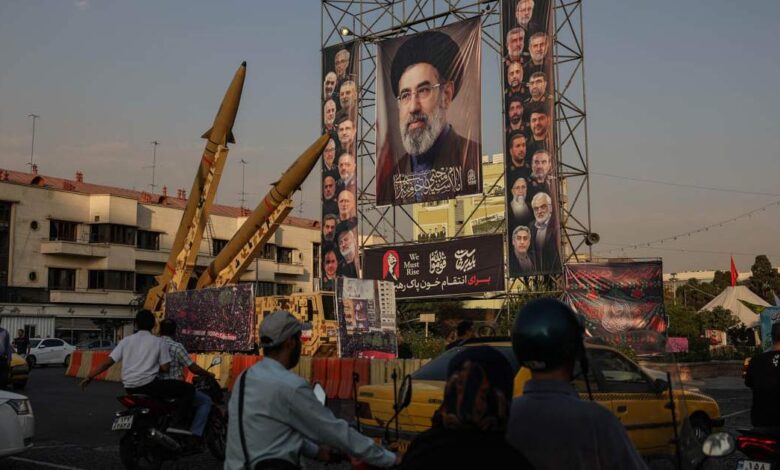
The shift in rhetoric follows a statement attributed to Supreme Leader Mojtaba Khamenei on Saturday, which ordered Iran’s armed forces to prepare for retaliation without geographic restrictions. The hardline daily Kayhan amplified this message, arguing that American and NATO facilities “in the heart of Europe” could be struck if US and Israeli attacks on Iran resume. The newspaper also identified the joint US-British base on Diego Garcia in the Indian Ocean as a target. For European defense planners, this represents a material change in the threat landscape, moving the potential blast radius of the conflict from regional airspaces to the borders of the European Union and the United Kingdom.
Iranian military officials have provided the operational rationale for this expansion. Mohammad Akraminia, the Army spokesman, stated that while the recent conflict extended from occupied territories to US bases in regional countries, a renewed attack could expand the “geography of the war” beyond West Asia. He confirmed that Iran is updating its list of potential US and Israeli targets. Ghassem Ghorayshi, a senior Basij commander, went further, asserting that the armed forces are no longer bound by previous limits on missile range, target selection, or the scale of operations. “In the past, target selection and missile ranges were restricted,” Ghorayshi said, attributing those limits to decisions made under former Supreme Leader Ali Khamenei. “From now on, the armed forces will have no restrictions on striking targets, determining missile range or the scale of missile operations.”
However, a significant gap exists between these political declarations and the technical capabilities assessed by Western experts. The remarks do not establish that Iran has developed new long-range missiles or formally codified a new military doctrine. A report in the newspaper Hamshahri cited speculation that Iranian missiles could reach targets 4,000 to 5,000 kilometers away, a range significantly beyond the roughly 2,000-kilometer limit Iran previously described as self-imposed. Yet, these longer-range estimates remain disputed within the defense community.
Western institutions offer a more cautious assessment of the threat’s practicality. The Washington-based Center for Strategic and International Studies (CSIS) lists Iran’s principal ballistic missiles with ranges generally around 2,000 kilometers, with some variants potentially reaching 3,000 kilometers. This suggests that while the theoretical range may have increased, the effective strike zone for high-accuracy payloads remains limited. Britain’s Royal United Services Institute (RUSI) noted that strikes as far as the UK may be theoretically possible, but would likely involve smaller, less accurate warheads traveling through defended airspace. The ability to extend a missile’s theoretical range does not necessarily guarantee its accuracy, payload capacity, or operational effectiveness against hardened targets in Europe.
The political stakes of this rhetoric are high. Hassan Ghashghavi, spokesperson for parliament’s National Security and Foreign Policy Committee, warned that renewed fighting could spread on a scale he described as “almost on the scale of World War III.” He suggested that Iranian retaliation could affect civilian infrastructure, stating, “If they leave your people in darkness, you should leave their people in darkness too.” Tehran lawmaker Kamran Ghazanfari also speculated that Iran might already possess nuclear weapons, a claim for which no evidence has been provided and which Tehran has not officially announced.
These military warnings are being leveraged in parallel diplomatic channels. Parliament Speaker Mohammad Bagher Ghalibaf stated that Tehran had delivered a “firm and rational response” to Washington, placing the ball in America’s court to prevent renewed fighting. Armed forces chief Ali Abdollahi outlined five conditions for lasting regional security: an end to fighting in Lebanon and Gaza, the lifting of sanctions and release of frozen assets, war reparations, recognition of Iranian authority over the Strait of Hormuz, and guarantees against renewed attacks. Senior Iranian officials told Reuters on Tuesday that despite diplomatic efforts involving Qatar and other mediators, Tehran and Washington remained far from an agreement.
The economic and security implications for Europe are complex. While the immediate likelihood of a large-scale ballistic missile strike on European soil remains debated by experts due to technical constraints, the rhetoric serves to raise the cost of any US military action in the region. For businesses and governments in the named countries—particularly those hosting US bases—the uncertainty regarding air defense requirements and potential supply chain disruptions adds a new layer of risk. The conflict is no longer being framed solely as a regional dispute but as a potential globalized confrontation, with the Strait of Hormuz and European airspace both cited as potential arenas for escalation.
As negotiations stall, the focus remains on whether these threats are purely coercive or indicative of a genuine doctrinal shift. The next critical data points will come from intelligence assessments regarding Iranian missile test activities and the outcome of ongoing mediation efforts in Qatar. Until then, European allies must prepare for a scenario where the geographic boundaries of the Iran-Israel conflict are contested not just on the ground, but in the air and at sea.