
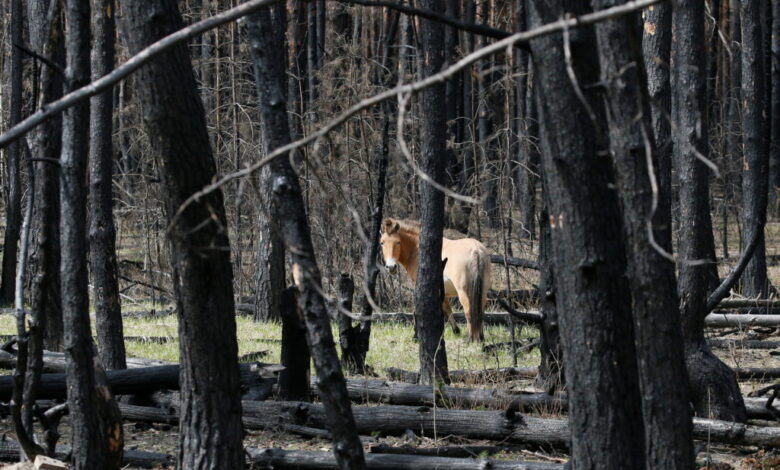
That early episode of monitoring and response marks the beginning of a 40-year narrative that has evolved from immediate panic to complex ecological and scientific study. Today, the 30-kilometer exclusion zone around the Chernobyl Nuclear Power Plant, located 65 miles north of Kyiv, is a landscape where human absence has allowed nature to stage a remarkable recovery. On contaminated land that remains too dangerous for permanent human settlement, Przewalski’s horses—stocky, sand-colored animals native to Mongolia—now graze freely. These horses, known as “takhi” or “spirit,” were introduced to the zone in 1998 as an experiment. Their presence is part of a broader biological rebound: wolves prowl the vast no-man’s-land spanning Ukraine and Belarus, and brown bears have returned after more than a century. Populations of lynx, moose, and red deer have also increased, transforming the area into a de facto nature reserve, despite the lingering radiation that renders it inhospitable to the majority of the human population.
This ecological resilience stands in stark contrast to the political and structural fragility of the site itself. The zone’s status as a refuge is precarious. When Russia invaded Ukraine in February 2022, Russian soldiers briefly took control of the strategically important area, situated between Belarus and Kyiv. A fire broke out, raising fears of a new nuclear disaster, though the soldiers withdrew by the end of March. More recently, a Russian drone strike in February 2025 caused significant damage to the New Safe Confinement (NSC), the giant steel structure built to contain the damaged Reactor 4. The strike punctured a hole in the steel structure and ignited a major fire. Although the International Atomic Energy Agency (IAEA) confirmed that no permanent damage was caused to load-bearing elements, the NSC “lost its primary safety functions, including the confinement capability.” The attack left a large hole in the roof and approximately 300 smaller holes created by firefighters attempting to control the blaze.
The vulnerability of the NSC is a critical concern for regional security. Plant director Sergiy Tarakanov warned in a December 2025 interview with Agence France-Presse that if the shelter is struck again by missiles or drones, such as an Iskander missile, it could cause a “mini-earthquake” and collapse. “No one can guarantee that the shelter facility will remain standing,” Tarakanov stated. If the protective radiation shelter collapses, radioactive dust and particles could escape from the damaged Reactor 4, putting Ukraine and neighboring regions at risk of contamination. Repairs are ongoing, with a temporary screen covering the main opening, but Tarakanov estimates it will take three to four years to fully restore the NSC’s safety functions. Currently, he notes, radiation levels at the site “remain stable and within normal limits.”
While the physical structure faces existential threats, the human legacy of the disaster continues to be dissected through genetic research. Studies led by the National Cancer Institute (NCI) and published in Science in 2021 provide insights into the intergenerational effects of the exposure. Researchers sequenced the genomes of 130 children and their parents, who had either worked on cleanup efforts or were evacuated from nearby towns. The children were born at least 46 weeks after the accident. The study looked for “de novo” mutations—random genetic changes that appear in children but not in either parent. The number of these mutations found in the children was similar to that in the general population, suggesting that radiation exposure from the accident did not significantly increase the rate of heritable genetic damage in this cohort. This scientific finding adds a layer of nuance to the public memory of the event, balancing the documented health concerns with genomic evidence.
Despite the official exclusion, human presence in the zone has not entirely vanished. Approximately one to two hundred people, mostly elderly women known as “Samosely” or self-settlers, continue to live within the radioactive “forbidden zone,” refusing to leave their homes. They live alongside a rotating staff of up to 3,000 scientists and workers who monitor contamination and manage the plant. Meanwhile, remnants of the abandoned town of Pripyat, which once housed 45,000 people, are being reclaimed by nature, with ghost villages scattered across the Zone of Alienation. In the UK, the memory of the 1986 plume persists in the agricultural sector, a reminder of how atmospheric transport can carry local disasters across continents.
As the 40th anniversary of the explosion is marked, the Chernobyl site remains a focal point for energy security and environmental science. The next verified development lies in the completion of the NSC repairs, a process estimated to take several years, and the continued stability of the radiation levels within the exclusion zone. For now, the balance holds: a wild, recovering landscape protected by a fragile steel shell, watched over by scientists and a small number of residents who never left, while the world beyond the 30-kilometer radius continues to monitor the long-term implications of the 1986 accident.