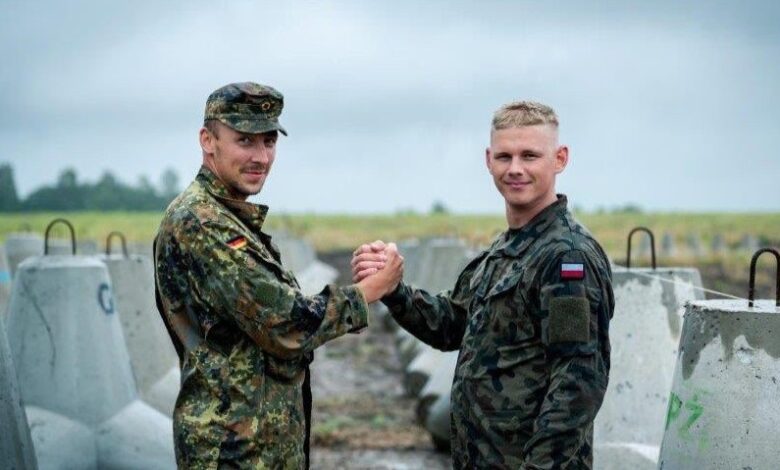
The German engineers are currently stationed near Budry in the Masuria region, close to the border with Russia. Their primary task involves placing concrete blocks known as Czech hedgehogs to impede the movement of enemy tanks. According to a Polish officer, the installation consists of three rows of these obstacles positioned approximately 200 meters back from the border, with a deep ditch and an additional line of hedgehogs marking the border itself. The officer noted that mines can be rapidly laid in the zone between the two lines of obstacles if an attack occurs.
Polish General Stanislaw Czosnek inspected the works on Thursday, stating that he was “very impressed” by the performance of his German colleagues. He noted that in the six weeks since their deployment, the German engineers have laid more than one kilometer of blocks. Accompanying him, German General Tito Gante emphasized the symbolic and strategic importance of the mission. “We stand ready to fight for democracy and freedom,” Gante said, adding that the Bundeswehr views maintaining peace with a credible deterrent as a core objective. The German contingent is scheduled to remain in Poland until October, after which the sappers will be redeployed to other sections of the East Shield.
The East Shield is a long-term project initiated by Poland in 2024, ultimately planned to stretch around 800 kilometers along the borders with Russia and Belarus. Polish Prime Minister Donald Tusk, who inspected the first completed section in November 2024, described the project as an investment in peace intended to “deter and discourage a potential aggressor.” Following the Russian invasion of Ukraine in February 2022, which significantly altered Poland’s security outlook, the Tusk government has increased defense spending for 2026 to 200 billion zlotys, approximately 46 billion euros. This expenditure represents nearly 5% of Poland’s GDP, making it the highest relative defense spending among NATO members.
Military cooperation between Germany and Poland has intensified since the end of the Cold War, formalized by NATO membership in 1999 and the recent signing of a German-Polish defense agreement on June 17, 2026. Beyond the East Shield, the Bundeswehr has supported Polish air defense by supplying Patriot air defense systems with German crews and participating in Enhanced Air Policing missions. However, the physical presence of German troops also carries political weight. Lukasz Jasinski, an analyst at the Polish Institute for International Affairs, noted that the deployment signals to Western partners that Poland’s eastern border is also the external border of the EU and NATO. While this cooperation is a government priority, it remains a point of contention for some political factions in Poland who cite historical grievances from World War II.