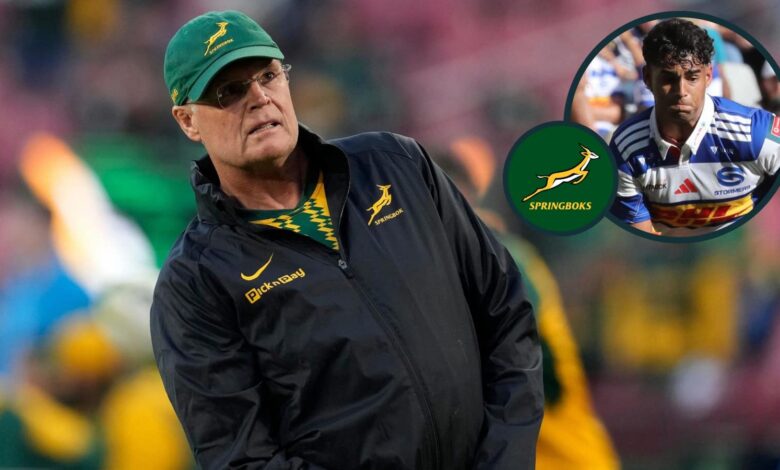
In a squad where the average age of the starting team was 32 against New Zealand five weeks prior, the current iteration presents an average age of 29. Erasmus has explicitly addressed this “drum” being beaten by media and public alike, noting the irony that the conversation has moved from the team’s dominance to their aging structure. “It’s heartwarming when South African people are talking about are the team getting too old?” Erasmus stated, highlighting that only two or three changes in the lineup are required to significantly lower the average age. He cited specific substitutions—swapping Morne van den Berg and Sacha Feinberg-Mngomezulu for Ethan Hooker and Canan Moodie, or replacing Cameron Hanekom with Emmanuel Tshituka and Ruan Nortje—as proof that a team with an average age of 27 or 28 is readily available within the current roster.
The strategic logic behind retaining the senior core is rooted in the coach’s philosophy that as long as these players perform, they cannot be omitted. This stance has not gone without friction. The departure of attack coach Tony Brown to the All Blacks, secured from 2028, was a notable loss, though Erasmus has publicly stated he holds no grudges regarding the move. The broader question of whether Erasmus is the greatest coach in rugby history remains a topic of debate among pundits. George Hook, a Rugby Odds pundit, suggests that judging coaching greatness requires looking beyond trophies to innovation and the transformation of a team’s identity. Hook noted that Erasmus took over a South Africa team ranked sixth in the World Rugby Men’s Rankings in 2018 and transformed them into 2019 world champions, a feat that earned him the World Rugby Coach of the Year award. His tactical innovation, particularly regarding the use of the bench and replacements, has fundamentally altered the modern game.
Despite the focus on the senior core, the path to the 2027 World Cup in Australia demands the integration of new talent. Victor Matfield, a Springbok legend, has argued that Erasmus is not afraid to make selection curveballs, particularly in the high-profile matches against France and Ireland. Matfield noted that several uncapped players, including Yaqeen Ahmed, Markus Muller, Riley Norton, and Luan Giliomee, have been held back from the Italy squad primarily due to their limited time in camp. “They don’t understand what they want to do, how they want to achieve it, so for him, he would rather let them get into the system,” Matfield explained on the Rivals podcast.
The competitive significance of these upcoming fixtures lies in their function as a proving ground. Matfield believes that performing well against an injury-stricken Italian team does not carry the same weight as succeeding against top-tier opposition like France or Ireland. “If they want to go to a World Cup next year, they need to be able to perform in those big games as well,” Matfield said. He predicts that Erasmus will utilize the final week of the tournament or the encounters with the European powers to force these young players to step up, proving they are ready for the pressures of global competition. This approach contrasts with a purely conservative selection strategy, as Erasmus aims to validate the next generation before the 2027 tournament cycle intensifies.
The current window is critical for both the short-term Nations Championship objectives and the long-term World Cup campaign. While the Italy match in Turin is expected to be a win, with pundits describing the outcome as “inevitable” given the Azzurri’s injury concerns, the real test lies ahead. The squad’s ability to balance the experience of its current core with the energy of its emerging talent will determine whether the “aging” narrative holds up against the evidence of sustained excellence. As the Springboks prepare to face the toughest challenges of the Nations Championship, the focus remains on whether the 2027 World Cup title can be secured, a goal that requires not just the current stars to remain fit, but the next wave of players to be ready to inherit the mantle.