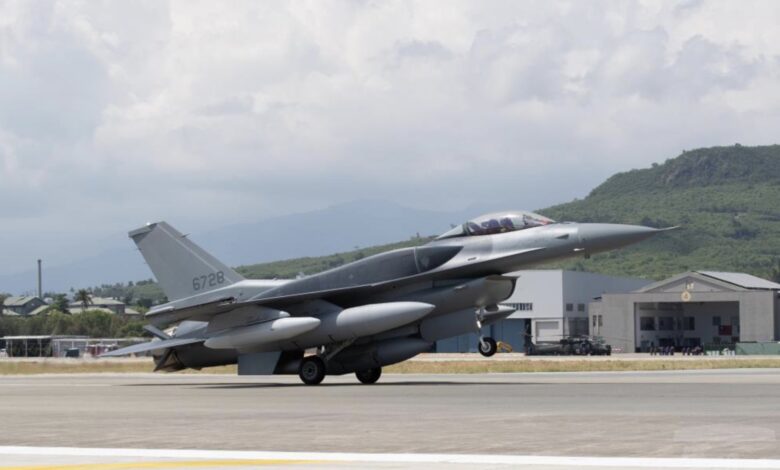
The delivery of this first pair is operationally significant because it initiates the replacement of the F-5 Tiger II fleet, which the 7th Tactical Fighter Wing at Chihhang retired in 2024. According to Taiwan’s Military News Agency, the Air Force will now proceed with equipment acceptance and training to systematically advance preparations for combat capability. While the immediate objective is to bolster the air defense posture against potential incursions, the broader strategic aim is to integrate advanced avionics and radar systems capable of countering modern threats, including stealth fighters such as the Chinese J-20.
The acquisition of the 66 F-16V Block 70s was originally approved by the United States in 2019 for a total value of approximately $8 billion. However, the timeline for delivery slipped repeatedly over the subsequent years. Lockheed Martin’s relocation of its F-16 production line from Fort Worth, Texas, to Greenville, South Carolina, in 2019 caused initial delays as the new facility became operational. These were compounded by supply chain shortages in 2021 and software issues identified during the upgrade process. More recently, in September 2026, delivery flights to Taiwan were held during stopovers in Hawaii and Guam due to adverse weather conditions, adding further months to the wait.
Technically, the new Block 70 aircraft offer distinct advantages over the ROCAF’s existing fleet of approximately 140 F-16A/B Block 20s. While both generations utilize the AN/APG-83 Active Electronically Scanned Array (AESA) radar, the new jets are equipped with conformal fuel tanks, which extend their operational range without significantly increasing drag. Additionally, the Block 70s are powered by General Electric F110 engines, replacing the Pratt and Whitney F100 engines found in the older aircraft. These enhancements are designed to improve persistence and lethality in contested airspace, allowing the ROCAF to maintain a more robust defensive perimeter.
The political context of the delivery is as critical as the technical specifications. The arrival of the jets came almost exactly one week after U.S. President Donald Trump met with Chinese President Xi Jinping in Washington. This timing has fueled concerns in Taiwan regarding the consistency of U.S. policy. In May, following a meeting in Beijing, President Trump stated that he was holding a new $14 billion arms package for Taiwan in abeyance, although an $11 billion package had been approved in December 2025. Beijing has repeatedly urged Washington to halt arms sales to Taiwan, viewing such transfers as violations of its sovereignty claims. Despite these pressures, U.S. officials have maintained that there has been no change in policy, with the State Department reaffirming its commitment to supporting Taiwan’s self-defense.
Defence Minister Wellington Koo addressed the development at parliament in Taipei, confirming that additional F-16Vs would arrive soon, though he did not specify dates. He emphasized that China’s intention to annex Taiwan by force remains unchanged, a stance that drives Taipei’s urgent need for upgraded air assets. The ROCAF currently faces a demanding operational tempo, requiring near-daily scrambles to shadow activities by the People’s Liberation Army Air Force. The introduction of the Block 70s is intended to alleviate this strain by providing more capable and reliable platforms for these intercept missions.
Washington has consistently declined to provide Taiwan with its most advanced fifth-generation fighters, such as the F-22 or F-35, citing strategic balance considerations. Consequently, the F-16V serves as the apex of Taiwan’s air combat capability. The gradual formation of combat capability for the 66 new jets will be a multi-year process, involving extensive pilot training and integration with existing air defense networks. Analysts note that while the delivery is a positive step, the overall pace of modernization remains a point of scrutiny, particularly as U.S. intelligence assessments suggest that a Chinese invasion before the 2028 presidential election is increasingly unlikely, yet the threat environment remains volatile.
As the first two F-16Vs begin their integration into the 7th Tactical Fighter Wing, the focus shifts from diplomatic negotiations to practical military readiness. The successful landing at Chihhang Air Base marks the end of a yearslong delay, but the next confirmed development will be the continued arrival of the remaining 64 aircraft and the progression of training schedules aimed at achieving full operational status for the expanded fleet.