
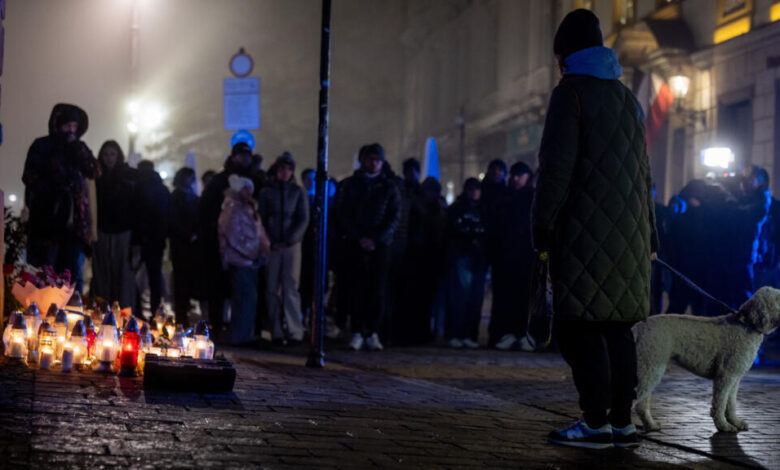
The shooting, which killed six people and wounded more than a dozen others, marks the deadliest fatal incident in Poland since the fall of communism in 1989. Authorities stated that the suspect fired from his vehicle at the Main Market Square, a major tourist destination. Among the six victims were four women and two men; three of the women and one of the men were Polish citizens, while a British man and an Austrian woman were also killed. Approximately 15 to 20 individuals were wounded, including five foreigners from the United Kingdom, Portugal, Russia, Germany, and Austria. Two police officers who intervened to stop the attack were injured and remained hospitalized in conscious condition as of Sunday.
Investigations have expanded beyond the scene of the shooting. Authorities discovered the bodies of the suspect’s mother, father, and sister at their family home in Ostrowiec Swietokrzyski, a city approximately 200 kilometers northeast of Krakow. The victims likely died from gunshot wounds. This development suggests a sequence of lethal actions preceding the public attack, though the precise timeline and intent remain subjects of active investigation. On Sunday, prosecutors formally opened an investigation into an “act of terrorism.” Additionally, Poland’s Interior Minister stated that the suspect was fascinated by “far-right ideologies.” A spokesperson for the Ministry of the Interior and Administration noted that the suspect was wearing military fatigues and various emblems, which investigators have “partially examined and interpreted.”
The legal status of the suspect is now moot in terms of trial, but the classification of the act carries significant legal weight. Distinguishing between a hate crime, a terrorist act, or a personal tragedy affects the jurisdictional handling of the case and the broader national security implications. With the suspect deceased, no criminal conviction can be rendered. However, the investigation will likely continue to assess whether the act meets the statutory definitions of terrorism under Polish law, which has implications for state emergency powers and public order measures.
The shooting has intersected with a parallel constitutional crisis in Poland, creating a complex procedural and political environment. The incident occurred just days before a critical session of the Constitutional Tribunal is scheduled for Tuesday. The Tribunal is currently at the center of a dispute between Prime Minister Donald Tusk’s governing coalition and the right-wing opposition, specifically the Law and Justice (PiS) party. The conflict centers on judicial appointments; the opposition accuses the liberal government of undermining the constitutional order, while the government claims it is correcting “political” nominations that conflict with European democratic standards. Tensions escalated recently when riot police blocked access to the court and a newly appointed judge declared she was taking over the role of the incumbent, who is close to President Karol Nawrocki.
In response to the Krakow tragedy, the PiS party called off planned protests for Monday and Tuesday, though they may resume later in the week. The primary security concern remains Wednesday’s Independence March, an annual event that attracts hundreds of thousands of right-wing supporters. The crowd composition ranges from Catholic conservatives to far-right and white-supremacist fringe groups. President Nawrocki has announced his attendance. Security services are monitoring the event with heightened concern that participants might deviate from the agreed route to converge on the Constitutional Tribunal. Prime Minister Tusk dismissed rumors of a ban on the march on social media, stating, “No one intends to ban the Independence March,” and urging participants to refrain from aggression. However, he warned against counter-demonstrations, acknowledging the risk of volatility.
Legal and political analysts suggest that the convergence of the mass shooting and the judicial standoff creates a fragile stability. Ewa Marciniak, a political scientist from Warsaw University, noted that the tragedy is likely to be exploited to deepen political divisions ahead of the 2027 parliamentary elections. She warned that the “mutual hostility among political leaders” could be exacerbated by the search for responsibility in the aftermath of the Krakow incident. Boguslaw Chrabota, a writer for Rzeczpospolita, described the current climate as one of “extremely destructive polarisation” that risks the institutional integrity of the state.
As the investigation into the “act of terrorism” proceeds, the focus will remain on the forensic evidence and the ideological indicators left by the deceased suspect. The legal system will face the challenge of defining the nature of the attack in the absence of a defendant, while the state must navigate the immediate security risks of the upcoming march and the ongoing constitutional dispute. The next formal steps include the continuation of the criminal investigation by prosecutors to determine the legal classification of the incident and the security protocols for Wednesday’s Independence March.

One Comment