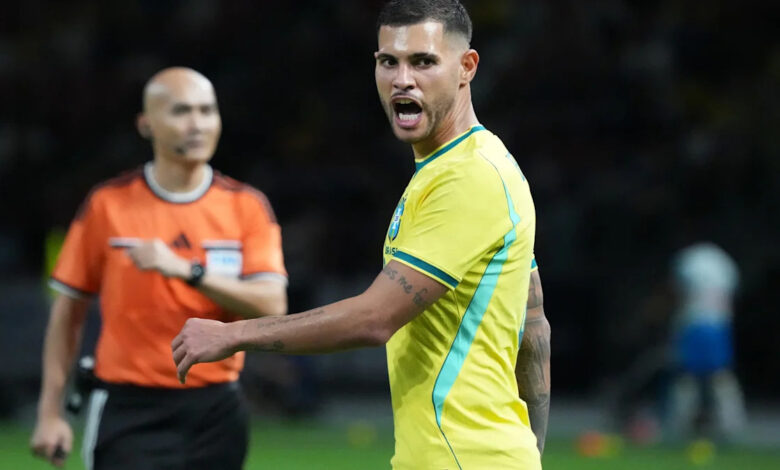
Brazil arrived in Singapore carrying the weight of a 3-2 loss to Japan on Saturday, a result that ended a three-game unbeaten stretch and left the team with questions about their defensive resilience. That defeat in Tokyo was the culmination of a mixed World Cup campaign that ended in the round of 16 against Norway in July. Since then, Ancelotti’s side had demonstrated potent attacking capabilities, evidenced by a 4-2 win over Australia and a 4-0 thrashing of India. However, the late collapse against Japan highlighted vulnerabilities, prompting a strategic pause in the squad’s rotation.
The absence of Ancelotti from the touchline on Tuesday was a direct consequence of the Japan match, where he was sent off alongside captain Raphinha for protesting a late winner. With Ancelotti serving a one-match suspension, assistants Francesco Mauri and Paul Clement took charge from the sidelines. This was not the first time Clement has managed the team in Ancelotti’s absence, a pattern that underscores the transitional nature of the current setup. For Raphinha, the suspension meant a missed opportunity to lead the line, a role that fell to a younger, more experimental group of forwards.
The tactical arrangement for the Singapore match was a deliberate shift toward a 4-4-2 or 4-3-3 hybrid, depending on the flow of play, designed to maximize width and create numerical superiority in the final third. The lineup reflected Ancelotti’s confidence in emerging talent. In goal, Bento started in place of 22-year-old Pedro Morisco, who had earned his first senior cap against Japan. The defensive line, featuring Wesley, Reis (or Cunha/Gabriel depending on source variance), Dias (or Gabriel), and Santos, was tasked with maintaining structure while the midfield trio of M. Gomes, J. Gomes, and Guimarães controlled the tempo.
Up front, the absence of Raphinha was replaced by the pairing of Endrick and Rayan, the latter having recently recovered from injury. Vinícius Júnior, who had scored twice against Japan, completed the attacking triangle. This configuration allowed Brazil to exploit the spaces left by Singapore’s 5-4-1 defensive block, a formation managed by Gavin Lee that prioritized compactness over possession. The match statistics highlighted Brazil’s control, with the Selecao dominating the final third and creating multiple clear-cut chances, while Singapore’s best opportunities came from set pieces and long-range efforts by players like Shah Shahiran and Song Ui-Young, which were either blocked or missed.
The result was a 4-0 victory, a margin that provided psychological relief after the narrow defeat in Tokyo. The goals, while not individually detailed in the provided match logs, were the product of sustained pressure and technical superiority. Singapore, coming off a 4-1 loss to Paraguay, offered limited resistance, with their only notable moment of discipline being a yellow card for Safuwan Baharudin for a foul on Endrick. The match also saw a brief injury stoppage for Izwan Mahbud, one of the few disruptions to Brazil’s rhythm.
This victory serves as a data point in Brazil’s broader reconstruction. The exclusion of established names like Alisson, Gabriel Martinelli, João Pedro, and Lucas Paquetá from the November squad signals a shift in priorities, with Ancelotti focusing on integrating newer faces into the international setup. The 4-0 result confirms that the squad’s depth remains strong, even in the absence of its most high-profile stars. However, the reliance on young players like Endrick and Rayan in the absence of experienced leaders like Raphinha raises questions about consistency in high-pressure scenarios, a concern amplified by the previous loss to Japan.
As the autumn international window closes, Brazil leaves Singapore with a boosted goal difference and a clearer picture of their squad dynamics. The next challenge will be to translate this experimental confidence into results against stronger opposition. For now, the 4-0 win at the National Stadium stands as a testament to the squad’s attacking prowess, even as the technical staff works to stabilize the defensive structures that were exposed in Tokyo. The journey toward the 2026 World Cup continues, with this friendly serving as a crucial step in refining the team’s identity under a new managerial regime.