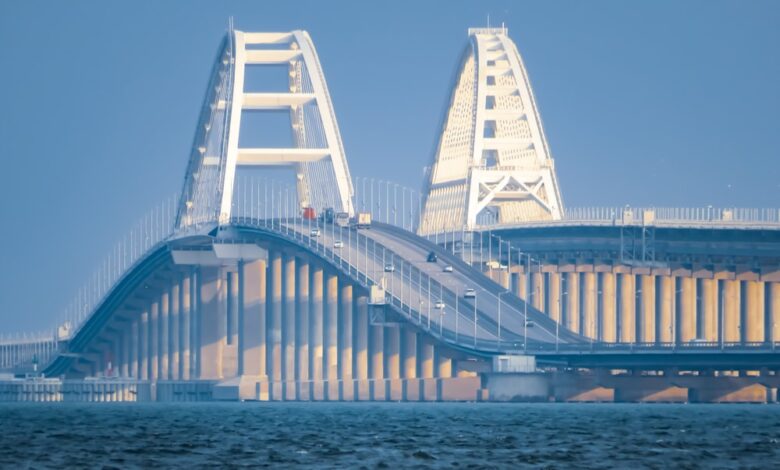
The attack, which took place overnight between November 16 and 17, followed an earlier strike on November 16 that had already damaged an arch near the navigable span, causing the structure to tilt and forcing the temporary suspension of vehicle traffic. According to Denys Shtilerman, co-owner and Chief Designer of Fire Point, the weapon used in the second strike was a Ukrainian-made Flamingo cruise missile. Shtilerman made this assessment while commenting on video footage purportedly captured by a missile-mounted camera during its final approach. While the footage appears to show the weapon impacting the structure, the specific type of munition remains unconfirmed by independent verification. Prior to the collapse, Russian-installed authorities in occupied Crimea issued missile threat warnings at 12:56 am, with additional alerts at 3:52 am and 5:03 am on November 17.
The Kerch Bridge is not merely a transportation artery; it serves as a prominent symbol of Moscow’s annexation of Crimea in 2014 and a primary supply route for Russian forces operating in the region. The disruption of this crossing creates immediate logistical constraints for the movement of troops and materiel between Russia’s Krasnodar region and the peninsula. Following the collapse, traffic was suspended again, severely restricting the flow across the strait. While Russian spokesperson Dmitry Peskov initially characterized the damage as “minor,” the subsequent collapse of the roadway section and the continued suspension of traffic suggest a more significant operational impact than initially acknowledged.
This targeted strike on the bridge occurred against the backdrop of a massive, coordinated Ukrainian drone offensive across Russian territory. Russia’s Defense Ministry reported that its air defense forces intercepted or destroyed 1,336 Ukrainian drones across 16 regions, a figure that exceeds the previous reported record of 1,254 drones shot down on October 29. The scale of this barrage indicates a broad strategic effort to degrade Russian air defense capabilities and disrupt logistics networks simultaneously. In the Moscow region, Mayor Sergei Sobyanin stated that approximately 600 drones had targeted the area since Sunday evening, with 191 intercepted. Interceptions were also reported over Crimea and in the waters of the Black Sea and Sea of Azov.
The targeting of the Kerch Bridge is part of a wider Ukrainian campaign to dismantle Russian logistics corridors. Since early October, Ukrainian forces have struck at least six bridges along major Russian supply lines, damaging transport links connecting Russia’s Rostov region with occupied southern Ukraine. These routes are essential for supplying Russian forces in the Zaporizhzhia, Kherson, and Crimea fronts. By striking the Kerch Bridge, Ukraine aims to isolate the occupied peninsula logistically, forcing Russia to rely on alternative, likely less efficient, maritime or rail connections if they remain available. The repeated targeting of this specific infrastructure highlights its strategic value to the Russian military command.
The extent of the structural damage to the Kerch Bridge remains a subject of varying reports. Satellite imagery from the time of the attack showed scorch marks and signs of damage, including deformation on the arch of the road bridge. While some reports indicated that traffic had been partially resumed with one lane open in each direction, the collapse of the section into the sea on November 17 suggests that the bridge’s capacity is significantly reduced. The Russian-installed head of Crimea, Sergei Aksyonov, confirmed the attacks and stated that specialists were assessing the damage to determine when traffic could be fully restored. The precise degree of structural compromise, and whether the bridge can withstand further strikes or heavy loads, is not publicly known.
These military developments have occurred despite ongoing diplomatic efforts to end the war. U.S.-brokered talks between Russian and Ukrainian officials took place in Abu Dhabi last week but failed to yield progress toward a peace agreement. The intensity of the recent drone campaigns and the deliberate targeting of high-profile infrastructure like the Kerch Bridge suggest that the conflict is entering a phase where kinetic pressure is being used to alter the strategic balance on the ground. For Ukraine, the goal is to degrade Russian logistics and demonstrate the vulnerability of occupied territories. For Russia, the challenge is to restore the bridge’s functionality while deterring further strikes on its logistical lifelines, a task complicated by the sheer volume of Ukrainian drones saturating its airspace.
As of the latest reports, the situation at the Kerch Strait remains tense, with the collapsed section of the bridge serving as a stark physical manifestation of the ongoing contest for control in the Black Sea region. The next confirmed development will likely involve the Russian military’s assessment of the bridge’s structural stability and the subsequent resumption of traffic, if at all, while Ukrainian forces continue to monitor the site for further opportunities to strike.