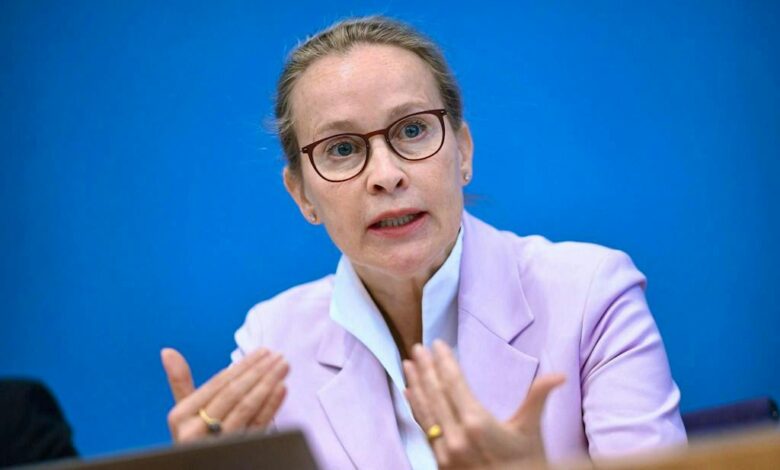
The crisis came to a head on July 11, when the Bundestag was scheduled to vote on three new judgeships. At short notice, the CDU/CSU parliamentary group removed Brosius-Gersdorf’s name from the agenda, citing accusations of plagiarism that had recently “surfaced.” This move meant the necessary two-thirds majority for her election—and, consequently, for the other two candidates on the ballot—was unattainable. The election of all three judges was aborted and postponed, an event described by opposition politicians as a “disaster for parliament” and considered unprecedented in the history of the Bundestag.
Brosius-Gersdorf, who is highly regarded in her field for her work on a commission to reform abortion law, stated that members of the CDU/CSU bloc had made it clear, both publicly and privately, that her election was “out of the question.” In her withdrawal statement, she explained that she wanted to avoid the row within the coalition from worsening and setting in motion a “train of events with unforeseeable consequences for democracy.” She also noted that persisting in her candidacy risked unraveling the entire process, which could endanger the other two candidates, whose nominations have also been on ice since the aborted vote.

The dispute over Brosius-Gersdorf’s nomination has been fueled by accusations from right-wing lawmakers and online campaigns that characterized the legal expert as having an “ultra-left background.” Critics, including fundamentalist groups and organizations such as CitizenGO, circulated tens of thousands of emails urging MPs to block her election, labeling her an “enemy of life” due to her belief that it is constitutionally possible to decriminalize abortion. Researchers have indicated that a far-right social media campaign, which painted the respected professor as an extremist, played a causal role in the suspension of the elections. Brosius-Gersdorf rejected these characterizations, describing much of the criticism as “defamatory and detached from reality” and accusing some traditional outlets of “slanderous journalism.”
The Federal Constitutional Court, based in Karlsruhe, is viewed as the “fifth organ” of the German political system, alongside the presidency, the Bundestag, the federal government, and the Bundesrat. Its primary role is to ensure that the Basic Law is upheld and to act as the guardian of citizens’ basic rights. The court consists of 16 judges, half chosen by the Bundestag and half by the Bundesrat, with all appointments requiring a two-thirds majority. This high threshold is designed to ensure the court’s independence and broad political consensus, making the recent breakdown in cooperation a significant blow to the institution’s reputation.

Chancellor Friedrich Merz, who took office in May, condemned the attacks on Brosius-Gersdorf, calling them “completely unacceptable.” However, the incident has strained relations within his coalition. Lars Klingbeil, the vice chancellor and co-leader of the SPD, praised Brosius-Gersdorf as an “excellent candidate” but directed strong criticism at her opponents within the coalition. “Those in the coalition who in the end didn’t stick to their word must urgently account for what happened there,” Klingbeil said. “This kind of incident cannot happen again.” Matthias Miersch, head of the SPD’s parliamentary group, held the CDU/CSU responsible, pointing to members who blocked the election despite an agreement reached in the responsible election committee.
The SPD has stated there is no reason to distance itself from the candidate, noting that she had received “great support” from the Green and Left parties as well. The party has indicated it will put forward a new suggestion for a suitable candidate, continuing the process for the remaining vacancies. The affair has overshadowed the government’s summer break and remains a burden on Berlin politics, raising questions about the stability of the coalition and the resilience of Germany’s judicial independence against political polarization.