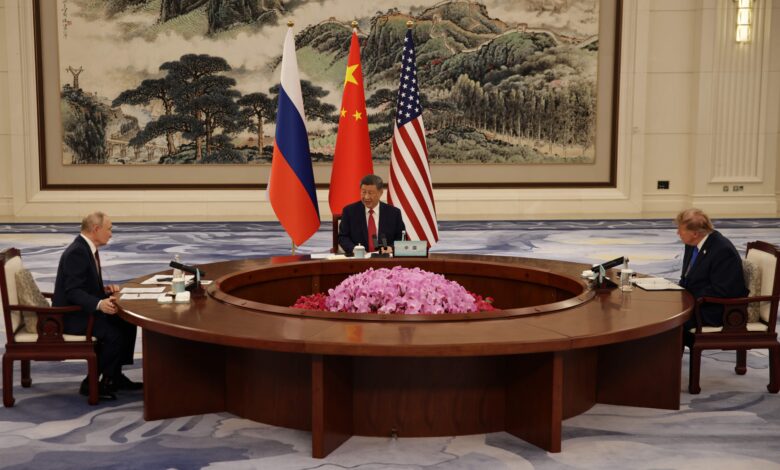
The declaration, released after the summit, focused on four primary pillars: reducing nuclear risks, reforming the United Nations, ensuring stable energy supplies, and addressing the immunity of state officials. The leaders stated that “nuclear war cannot be won and must never be fought” and committed to increasing the production and supply of petroleum. They also agreed that the International Criminal Court and similar institutions “must not abuse their jurisdiction,” a point that resonates with current legal tensions involving the three nations. While the rhetoric was grand—Trump declared, “We are really making history,” and Xi called the interaction a “mandatory requirement” rather than a choice—the substance of the agreement was modest, avoiding the major flashpoints that have defined international relations in recent years.
The omission of specific conflicts is perhaps the most telling aspect of the summit. The joint statement made no mention of the war in Ukraine, the US conflict with Iran, or the semiconductor and artificial intelligence trade disputes. It also excluded any reference to Taiwan. Trump noted that he had raised the issue of Ukraine in separate one-on-one meetings with both Xi and Putin earlier in the day, but these topics were deliberately left out of the trilateral consensus. This exclusion highlights the divergent goals of the three actors: China has maintained official neutrality regarding Russia’s invasion of Ukraine, rejecting accusations of tacit support while calling for political settlement; Putin highlighted a shared interest in ending the war; and Trump, while seeking to resolve conflicts, found common ground only on broader strategic stability rather than specific territorial or regime outcomes.

The nuclear dimension of the summit carries significant weight, particularly given that the New START treaty, the last major arms control pact between the US and Russia, expired in February. Trump has expressed a desire for a “new, improved and modernized” deal that includes China. However, analysts note that China has less motivation to accept strict limits, as its arsenal of over 600 warheads is significantly smaller than the 5,000+ warheads held by both the US and Russia. Daryl Kimball, executive director of the Arms Control Association, cautioned that the meeting could at best initiate a process for sustained talks, warning against viewing it as a dramatic breakthrough. “We need more than diplomatic theater and photo opportunities,” Kimball said, noting that a single meeting is unlikely to yield immediate, tangible reductions in arsenals.
Energy security formed another central pillar of the declaration, with the leaders committing to stabilize global supplies. This focus comes at a time of heightened volatility, driven by the US attack on Iran in February, which led to Tehran closing the Strait of Hormuz, a waterway through which a fifth of the world’s oil previously transited. Additionally, Ukrainian strikes on Russian energy facilities have further strained the market. By framing energy stability as a shared priority, the three powers are attempting to manage the economic fallout of these conflicts, even as the conflicts themselves continue.
The summit also touched on the need for UN Security Council reform, acknowledging that the current structure may not be responsive enough to modern global challenges. Xi emphasized the need to shed a “Cold War mentality,” a sentiment echoed by Putin, who described the talks as “open and candid.” Trump, greeting Putin as his “friend” in a separate bilateral meeting, described his relationship with Xi as “very special,” signaling a personal diplomatic approach that contrasts with the institutional rigidity of previous administrations.
Whether this gathering marks a pivot in world history or becomes a forgotten photo op remains to be seen. The leaders have established a channel for direct communication on existential risks, but the underlying geopolitical tensions—ranging from the expansion of NATO to competition in the Indo-Pacific—remain intact. As the leaders departed the Shenzhen villa, the world was left with a declaration of intent rather than a treaty of resolution, with the next developments likely to unfold in the separate bilateral tracks where the harder questions of Ukraine and Iran await.