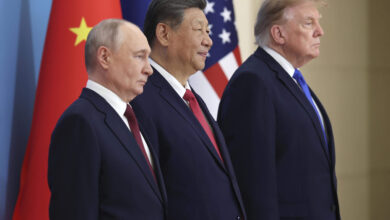
The summit in Shenzhen represents a marked departure from the diplomatic isolation that has characterized recent years. Trump, speaking just before the meeting, described his relationship with Putin as “great” and stated that the U.S., Russia, and China are “uniquely positioned” to reduce the world’s nuclear weapons stockpile. “As the world’s three largest nuclear powers by far… we are uniquely positioned to discuss how to reduce the number of nuclear weapons on earth and also to lessen the risk that those weapons will ever be used,” Trump said. He characterized the gathering as an “honor,” noting that “too often past leaders have avoided talking to nations with whom they had disagreements,” a stance he claimed the current administration felt “the opposite” of.
Preceding the trilateral session, the leaders engaged in intensive bilateral meetings that set the tone for the broader discussions. Trump spent approximately 40 minutes in bilateral talks with Putin, during which the Russian president’s aide, Yuriy Ushakov, stated that the war in Ukraine was the primary topic. Later, Trump held a working lunch with Xi Jinping that lasted over an hour, starting later than originally planned. During this meeting, Trump thanked Xi for an “incredibly warm welcome” and highlighted the establishment of a Trade Council agreed upon during a summit in Beijing in May. “We divided the tariffs and lowered them in a very fair way,” Trump said, asserting that the council had created “greater balance in very one-sided relations.” Xi Jinping, in response, described U.S.-China relations as stable and improving, emphasizing a new definition of “constructive China-U.S. relations of strategic stability” based on respect, fairness, and reciprocity.
The agenda for the trilateral talks, which the Kremlin had initially allotted a maximum of one hour for, encompassed critical global issues: nuclear arms control, the ongoing wars in Ukraine and Iran, and global trade. Chinese Foreign Ministry officials had indicated that the leaders would discuss global peace and strategic stability. Xi Jinping, who state media reported would lead the trilateral portion, outlined four “correct” ways for large countries to interact: mutual respect, peaceful coexistence, win-win cooperation, and adherence to dialogue. He stressed that for major nations, positive interaction is “not a choice but a necessity.” Trump echoed this sentiment, telling Xi and Putin they were “really making history” with this unprecedented gathering.
The significance of these talks extends beyond the immediate diplomatic exchange to the broader structure of international security and economic order. For the United States, the engagement represents an attempt to reassert influence in a multipolar world by directly engaging with both its primary strategic competitor, China, and its geopolitical adversary, Russia. Trump’s emphasis on nuclear reduction suggests a strategic pivot toward arms control, a domain where U.S.-Russia bilateral frameworks have largely stalled. By bringing China into this conversation, the U.S. seeks to include the third major nuclear power in the conversation, potentially creating a new trilateral framework for strategic stability.
However, the inclusion of the war in Ukraine on the agenda introduces a complex dynamic. Ukraine’s Foreign Minister, Andrii Sybiha, had called on Washington and Beijing to pressure Putin to end the war and to avoid giving him the “illusion of a return to the division of spheres of influence.” The fact that the war was the “main topic” of the Trump-Putin bilateral meeting, yet the trilateral agenda also includes Iran and trade, suggests a multi-layered negotiation where security concerns are interlinked with economic interests. China’s position remains one of “strategic stability” and “peaceful coexistence,” a diplomatic language that often prioritizes the preservation of the status quo and the avoidance of direct confrontation with Russia over direct intervention in the Ukraine conflict.
The economic dimension of the summit is equally pivotal. Trump’s comments on tariffs and the “Trade Council” signal a move toward a more structured, albeit competitive, economic relationship with China. By framing the reduction of tariffs as a “fair” division, the U.S. administration is attempting to legitimize a new trade architecture that moves away from the unilateral sanctions and punitive measures of previous administrations. This shift is likely to be watched closely by other APEC members and the broader international community, as it could reshape global supply chains and investment flows.
As the three leaders concluded their discussions, the immediate outcome was a reaffirmation of dialogue over confrontation. The “historic” nature of the meeting, as labeled by Trump, underscores the break from the past decade of diplomatic estrangement. Yet, the unresolved tensions remain. The war in Ukraine continues, and the nuclear arsenals of the three powers remain vast. The “unthinkable power” of these weapons, as Trump described it, is a reminder of the high stakes involved. The next step in this geopolitical realignment will be determined by whether the commitments made in Shenzhen—on trade, arms control, and conflict resolution—translate into concrete actions or remain symbolic gestures of a new, but untested, era of great power engagement.