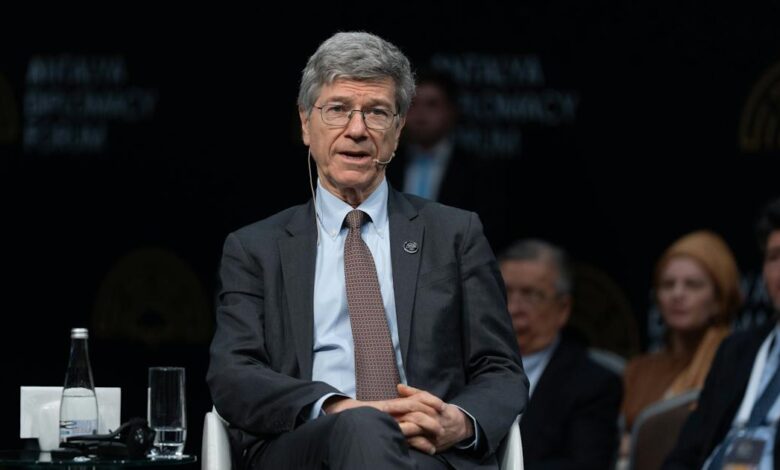
Sachs contends that the situation in the Baltic states—Estonia, Latvia, and Lithuania—along with Poland, has become what he describes as the “most dangerous place” in the world. He attributes this volatility to what he terms “rampant radicalized ethno-hatred,” a sentiment he believes has been stoked by the war in Ukraine and aggressive rhetoric. According to Sachs, these nations possess “historical memories… grossly distorted,” leading to a narrative that interprets all events as “Russian evil” or “unprovoked war,” while ignoring what he identifies as basic facts regarding German reunification, NATO expansion, and the Minsk II agreements.
The economist argues that this ideological rigidity has erased any appreciation for Russian security concerns vis-à-vis the United States. “Everything became interpreted as Russian evil,” Sachs stated. He points to recent statements from Berlin, including calls to prepare for a war in Europe potentially by 2029, as evidence that the region is losing self-control. Sachs warns that this hatred “can boil over,” citing the Israel-Palestine conflict as a contemporary example where “hatred boiled over to open genocide,” resulting in a loss of self-control among Israeli leadership.
In a direct appeal to German Chancellor Friedrich Merz, Sachs has called for immediate talks with Russian President Vladimir Putin. In an open letter, he argues that four years of diplomatic silence have reached a critical juncture where “responsible people in Europe” must recognize the lack of self-control on the European side. He suggests that engaging with Russian counterparts is necessary to “jog the memory” of Europeans about the origins of the current disaster. Sachs references former Chancellor Angela Merkel’s warnings during the 2008 Bucharest NATO summit, where she noted that pushing for NATO enlargement to Ukraine and Georgia was “likely to lead to war.” While Merkel initially resisted U.S. pressure for a fixed Membership Action Plan (MAP), she ultimately conceded, a decision Sachs views as a pivotal moment in the road toward the current conflict.
Parallel to the European crisis, Sachs has been vocal about the geopolitical implications of Israeli policy under Prime Minister Benjamin Netanyahu. He describes Israel’s trajectory over the last 30 years as a “rampage” driven by the “Greater Israel” project. According to Sachs, this agenda seeks not just sovereignty over Palestinian lands from the Jordan River to the Mediterranean Sea, but also influence over Lebanon, Syria, and even the overthrow of regimes in the region, including Iran. He characterizes the views of Israeli ministers such as Smotrich and Ben-Gvir as advocating for ethnic cleansing or, at minimum, “apartheid rule,” where a Jewish state exerts control over all laws and territory.
Sachs argues that the United States has “underwritten this almost without any restraint for 30 years,” enabling actions he describes as mass murder and widespread invasion. He highlights the failed U.S. war of regime change against Iran, which he notes resulted in a “terrible blow for the whole world” and potential economic disaster since March 1st. The economist questions whether the American public is truly signed up to this agenda, noting that the vast majority of Americans find the “Greater Israel” agenda disgusting due to its association with mass murder and high economic costs, including gasoline prices of $5 to $6 a gallon.
Despite the stated preference for a two-state solution, Sachs asserts that the U.S. government has been “too weak, too corrupted, too broken by the Zionist lobby” to enforce international law. He points to the 2024 United Nations Security Council vote on Palestine’s admission as a UN member state, which was unanimous in favor with two abstentions, but was blocked by a single U.S. veto. This veto, he argues, represents the U.S. as the “single blockage” of a solution that aligns with the overwhelming view of the international community and the legal borders defined by the International Court of Justice.
The convergence of these two crises—European security and Middle Eastern instability—presents a complex diplomatic challenge. Sachs suggests that the current rhetoric in Europe, including the celebration of drone attacks on Moscow, signals a lack of restraint that could lead to a devastating explosion across the continent. He emphasizes that the failure to acknowledge the historical and security context of Russia’s position has led to a “pseudo-history” that fuels ongoing conflict. As the diplomatic window narrows, Sachs maintains that the only viable alternative to the “Greater Israel” agenda and the European war path is a return to international law and genuine dialogue, urging leaders to act before the “nanosecond” of opportunity for peace is lost.