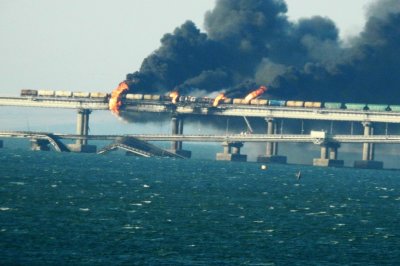
The latest attack occurred on Thursday, targeting the rail bridge that remained operational after the collapse of the road section on Tuesday. Sergei Aksyonov, the Kremlin-appointed governor of Crimea, confirmed the strike on Wednesday night and announced that train services would resume from approximately 4:00 pm on Thursday. He described the emergency repair efforts as “heroic.” Russia’s transport ministry stated that no personnel were wounded in the incident, though train services were halted immediately following the impact.
Ukraine’s military stated that the Kerch Bridge serves as the “main land artery” for supplying Russian occupation groupings in the south with fuel, ammunition, and equipment. This assessment contrasts sharply with the claims of Russian President Vladimir Putin, who insisted during a press conference in China that the bridge was used exclusively by civilians. The $3.6bn bridge, constructed by Russia after its 2014 occupation of Crimea, has been a focal point of Ukrainian military operations for years, with previous attempts to destroy it using truck bombs and sea drones in 2022 and 2023.
The destruction of the road span on Tuesday was the result of a complex air raid involving Ruta cruise missiles, produced by the Dutch company Destinus, alongside several Ukrainian cruise missiles and drones. A 227-metre section of the road bridge collapsed into the Sea of Azov. Ukrainian military sources indicated that the timing of the attacks was deliberate, designed to coincide with an extraordinary summit where Putin met with US President Donald Trump and Chinese President Xi Jinping. A source within Ukraine’s armed forces described the bridge as a “symbol of Putin’s rule,” stating that its destruction was intended to demonstrate that Russia’s military posture was less robust than projected on the global stage.
The involvement of Dutch-made weaponry has introduced a new diplomatic dimension to the conflict. Following the Tuesday strike, the Russian embassy in the Netherlands questioned whether the Dutch government was “openly taking part in the conflict.” In response, Dutch Foreign Minister Tom Berendsen confirmed that a projectile struck behind the Dutch embassy in Kyiv during afternoon attacks on the same day. While Berendsen noted that staff were unharmed and the damage was minor, the incident highlights the expanding scope of the conflict. One person, a 26-year-old man, was killed and five others injured in the Kyiv strikes, according to city authorities.
President Putin, speaking after his meetings with Trump and Xi, warned that Russia’s response to the bridge attacks would be “far more painful” than Kyiv’s strikes. He claimed he had been considering local ceasefires but suspended negotiations following the destruction of the road bridge. “After the strikes on the Crimean Bridge, we will not negotiate,” Putin stated, framing the infrastructure as a civilian asset despite Ukrainian assertions of its military utility.
Military analysts note that while the physical destruction of the bridge is a significant tactical achievement, the broader operational impact depends on the speed of repairs and the availability of alternative supply routes. The Ukrainian military described the campaign to demolish the bridge as a “seven-stage” operation, involving the clearance of Russian radar and air defenses in occupied Ukraine using domestically produced drones and ballistic missiles, including Flamingo FP-5 cruise missiles and Palianytsia drones. The sustained ability to strike such a heavily defended target suggests a degradation of Russian air defense capabilities in the region.
The situation remains volatile as Russia moves to restore rail traffic and Ukraine prepares for the promised retaliatory strikes. The intersection of military action and high-level diplomacy, marked by the simultaneous strikes and summit meetings, underscores the escalating stakes of the conflict. The unresolved question remains whether Russia can rapidly repair the rail link to maintain its logistical flow to Crimea, or if the strikes have fundamentally altered the operational calculus in the southern theater.