
The missile incident has raised acute legal and strategic questions regarding the prohibition of force under international law. Article 2(4) of the United Nations Charter requires states to refrain from the threat or use of force against the territorial integrity of another state. Legal analysts note that the characterization of the November 20 events depends heavily on intent. A deliberate launch into Poland would constitute a clear violation of the prohibition of force, engaging the rules of interstate military operations. However, if the missiles were aimed at Ukraine and entered Polish airspace due to malfunction or loss of control, the legal implications are more nuanced. While such an incursion remains a serious violation of sovereignty, it may not meet the higher threshold of an “armed attack” as defined by the International Court of Justice in its 1986 judgment in *Military and Paramilitary Activities in and against Nicaragua*. The distinction is critical: an incident can violate the prohibition of force without necessarily triggering the full self-defense mechanisms associated with an armed attack. Polish officials have treated the event as a protective security matter, but the lack of conclusive evidence regarding the missiles’ intended destination leaves the legal characterization open to interpretation.
This security tension coincides with a significant shift in Poland’s regional diplomatic posture, highlighted by Sikorski’s visit to Budapest. His journey marked the first time a Polish foreign minister had visited Hungary in twelve years, symbolizing an effort to repair relations that had deteriorated under the previous Hungarian administration. During talks with Hungarian Foreign Minister Anita Orbán, Sikorski stated that Poland is prepared to represent Hungary and the wider Central European region in negotiations regarding the end of Russia’s war against Ukraine. This offer comes at a time when Hungary’s Prime Minister, Péter Magyar, has signaled a change in diplomatic priorities, having made his first foreign trip to Warsaw after taking office. The two nations are also working on practical cooperation, including energy security via Poland’s liquefied natural gas terminal and improved transport links, with bilateral trade standing at approximately 15 billion euros.
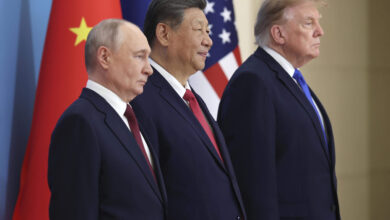
However, the path to regional unity is obstructed by deep-seated disagreements. Hungary has reiterated that it will not allow weapons shipments to Ukraine to pass through its territory, a stance that complicates the logistical support networks vital to Ukraine’s defense. Sikorski warned during the visit that Russia could use the peace process to drive a wedge between Western countries, noting Moscow’s apparent lack of willingness to agree to a ceasefire. He also criticized the high-profile engagement between the United States, China, and Russia, arguing that it gives the Kremlin a “misleading sense of importance” despite Russia being an “economic dwarf” compared to the European Union.
While Warsaw and Budapest seek to stabilize their bilateral relationship, a more volatile crisis is erupting between Poland and Ukraine. Tensions have escalated following a decree by Ukrainian President Volodymyr Zelensky naming a unit of the Special Operations Forces after the Ukrainian Insurgent Army (UPA). The UPA, which operated in the 1940s and 1950s, is viewed in Ukraine as a symbol of the struggle for independence against the Soviet Union and Nazi Germany. In Poland, however, the group is associated with the 1943–45 massacres in Volhynia, which Warsaw describes as a genocide of ethnic Poles, with estimates of around 100,000 victims.
Polish President Karol Nawrocki has condemned the decree as the “glorification of bandits and killers” and is considering stripping Zelensky of the Order of the White Eagle, Poland’s highest state honor. Nawrocki has already consulted the council of the order and stated he will make a decision “in due course.” The controversy has drawn criticism from across the Polish political spectrum, including Prime Minister Donald Tusk, who urged Kyiv to find a solution, warning that “hard business” would determine relations if empathy failed. Zelensky’s chief of staff, Kyrylo Budanov, traveled to Warsaw to ease tensions, but the visit appears to have yielded no immediate results, with Tusk later admitting that “diplomacy has yielded no results.” The dispute has also affected practical cooperation; Zelensky, who typically uses the Polish airport of Rzeszów for foreign travel, recently opted to fly to the UK via Moldova, though Tusk insisted the airport remained open to him.
The convergence of these three issues—border security, regional mediation, and historical memory—presents a formidable challenge for Warsaw. The missile incursion demands a calculated response that balances sovereignty with the risk of escalation. The diplomatic outreach to Hungary seeks to isolate Moscow by maintaining the cohesion of the Visegrád Group, even as Budapest continues to block transit routes for Ukrainian aid. Meanwhile, the rift with Kyiv threatens to undermine the trust necessary for a partnership that has been pivotal in supporting Ukraine’s war effort. As Poland prepares for a conference on Ukraine’s post-war reconstruction later this month, the unresolved tensions over the UPA naming and the legal status of the missile incursion remain unresolved, leaving Warsaw in a position where it must simultaneously defend its borders, manage its allies, and navigate the complex web of historical grievances that continue to shape the security architecture of Central Europe.

One Comment