
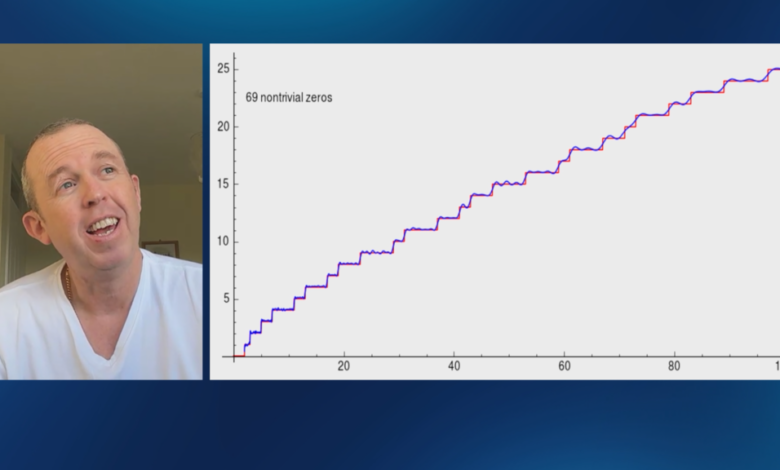
The Riemann hypothesis, a conjecture concerning the distribution of prime numbers, has resisted solution since it was first proposed in 1859. It is one of the seven Millennium Prize Problems, a set of unsolved mathematical challenges identified by the Clay Mathematics Institute. Brian Conrey, a leading expert on the hypothesis who reviewed an earlier Claude paper on the subject for Anthropic in August, characterized the announcement as “the biggest thing that’s ever happened in mathematics.” His assessment underscores the potential magnitude of the development, yet the mathematical community remains divided on its current status.
The technological significance of Alpöge’s work lies in the scale of the computation. By leveraging Claude, Alpöge was able to construct a proof that exceeds the capacity of any single human to read or audit in a reasonable timeframe. The 17 million lines of code represent a comprehensive logical argument, but one that is opaque to traditional peer review. This marks a shift from mathematics as a discipline of human-readable logic to one of machine-verified complexity, raising questions about where the boundary lies between a computational result and a mathematical proof.
Tony Padilla, a theoretical physicist at the University of Nottingham, offers a grounded perspective on the implications. He notes that a confirmed proof of the Riemann hypothesis would “reach into so many other areas” of mathematics, as a vast number of existing proofs rely on the assumption that the hypothesis is true. If verified, the result would stabilize or potentially invalidate a significant portion of current mathematical theory. However, Padilla emphasizes that the current state of the work is “very early days.” He warns that the process of converting the machine-generated code into a human-readable format, a prerequisite for formal acceptance by the mathematical community, could take years.
The challenge is not merely logistical but epistemological. In mathematics, a proof must be understandable to other experts to be considered valid. The current deliverable is a black box of code. Padilla points out that “there may be problems and we don’t know,” highlighting the uncertainty inherent in relying on an AI system for such a foundational task. The lack of transparency in the process has drawn criticism regarding the interests of the developers. Padilla acknowledges that Alpöge, as an employee of Anthropic, has “commercial interests at heart.” Consequently, he argues it is “absolutely crucial that everything is shared in a way that the community can follow,” urging a transparent release of the methodology and intermediate steps.
This incident raises broader questions about the role of artificial intelligence in scientific discovery. The ability to generate proofs of this magnitude suggests that AI is moving beyond assisting with calculations to actively constructing logical frameworks. However, the reliance on a proprietary system like Claude introduces a dependency on the vendor’s infrastructure and potential biases. For the mathematical community, the immediate task is to develop new verification standards that can handle codebases of this size without compromising the integrity of the peer review process.
While the commercial and academic stakes are high, the practical reality remains that the proof is unverified. The 17 million lines of code sit as a testament to computational power, but until they are translated into a form that human mathematicians can scrutinize, the Riemann hypothesis remains, officially, unsolved. The next confirmed development will not be a press release, but the slow, painstaking work of translation and audit. As Padilla notes, this process “can take years,” a reminder that in mathematics, even with the speed of AI, truth is measured in time and transparency.




One Comment