
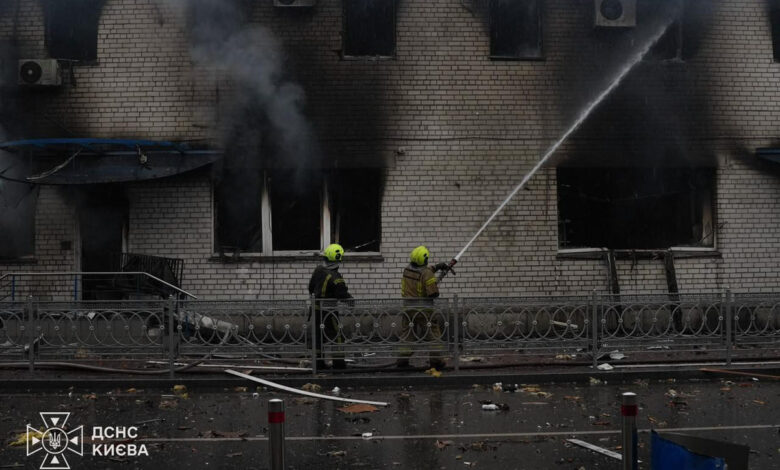
The event unfolded against the backdrop of a massive Russian offensive involving Kalibr cruise missiles and drones targeting multiple regions of Ukraine. The strikes resulted in eight confirmed deaths in Kyiv and Lviv, with dozens of others injured. Railway infrastructure across Ukraine was damaged, disrupting train services. For Poland, located just across the border, the proximity of these attacks has shifted the narrative from distant geopolitical conflict to an immediate, tangible security concern for its own territory.
Polish military officials have confirmed that they are investigating the incident. Lieutenant Colonel Jacek Goryszewski, spokesperson for the Operational Command of the Polish Armed Forces, stated that the military is reviewing radar data and investigating reports of “two possible violations” of Polish airspace. He noted that the video footage circulating online appeared to match readings from Polish radar systems. While the military has not yet confirmed the type or origin of the object, a ground search and rescue team was dispatched to the area between Chmielek and Nowy Lipowiec, located approximately eight kilometers from the border with Podkarpackie Voivodeship.
Local authorities corroborated the occurrence of a crash. Andrzej Szarlip, head of Biłgoraj County, confirmed that an unidentified object had fallen in the area and that residents had heard the explosion. He assured the public that police and firefighters are working at the scene and that there is currently no threat to the general population. In a statement on social media, Polish Prime Minister Donald Tusk said he had received briefings from Defence Minister Władysław Kosiniak-Kamysz and Interior Minister Marcin Kierwiński. Tusk emphasized that there is no current threat from the air, though appropriate services remain active at the scene.
The diplomatic and strategic implications of the incident are already being assessed. Marcin Bosacki, Deputy Foreign Minister of Poland, indicated that the Foreign Ministry had received information from the military regarding the possible crash of a Russian weapon in Biłgoraj County. He added that the Ukrainian side had provided relevant information. The timing of the attack is significant, occurring just hours after trilateral talks between Donald Trump, Vladimir Putin, and Xi Jinping in China. Analysts suggest that the strike may be an attempt by Russia to demonstrate continued military capability and increase political pressure during ongoing negotiations. This pressure coincides with European leaders meeting in Berlin to discuss further support for Ukraine, underscoring the urgency of strengthening Ukrainian air defenses as a means of protecting not only Ukraine but also NATO territory.
In response to the threat, Polish authorities increased the readiness of their air defense systems. The airport in Rzeszów suspended operations amid the heightened threat level. Earlier in the morning, an air raid alert was issued in the eastern Polish city of Lublin, where sirens sounded. Residents of Lublin and the Subcarpathian Voivodeship received emergency notifications from the Government Security Center warning of a potential air attack. The alerts instructed citizens to find a safe place and follow the instructions of emergency services. Military aircraft were scrambled, and monitoring of the airspace was stepped up in response to missile activity near Ukraine’s western borders.
The broader context of the attack involves a coordinated effort to degrade Ukrainian infrastructure and morale. In Lviv, Mayor Andriy Sadovyi warned that a group of Kalibr cruise missiles was heading toward western Ukraine. At 7:02 a.m., Maksym Kozytskyi, head of the Lviv Regional Military Administration, warned that two more cruise missiles were approaching the region, which was under a massive missile and drone attack. Explosions were also reported in Ivano-Frankivsk. The use of long-range cruise missiles highlights the reach of the Russian attack, placing pressure on air defense systems that are already stretched thin.
For now, the focus in Poland remains on forensic investigation and security stabilization. The military is determining whether the object was a stray missile, a drone, or another type of debris. While no injuries have been reported in Poland from the Chmielek incident, the disruption to local life and the suspension of airport operations in Rzeszów illustrate the immediate economic and logistical friction caused by cross-border security threats. The incident serves as a stark reminder that the conflict in Ukraine has direct, measurable effects on neighboring NATO states, influencing everything from air travel schedules to military deployment levels.
As the investigation continues, attention turns to the next steps in both the military and diplomatic arenas. The Polish government is expected to release further details on the nature of the object once the scene is secured. Meanwhile, the European leaders in Berlin are likely to address the implications of this airspace breach in their discussions on Ukraine support. The stability of the Polish-Ukrainian border region will be closely monitored in the coming days, with air defense readiness remaining a key metric for assessing the ongoing risk to regional security.