

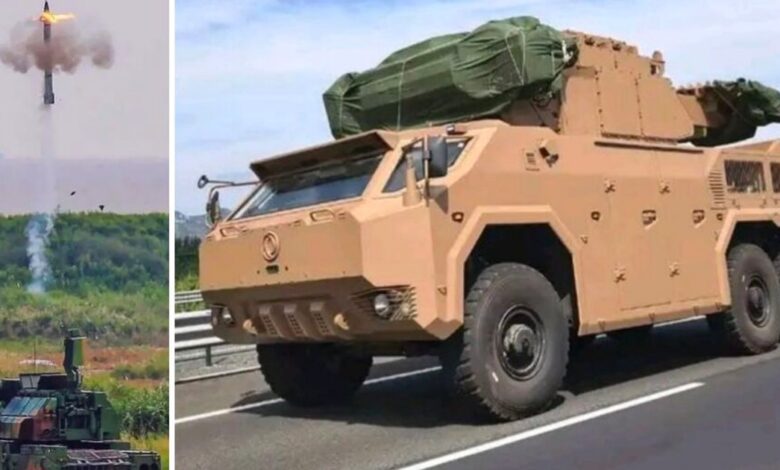
The HQ-17 is a Chinese adaptation of the Russian Tor-M1 platform. It is widely assessed to possess capabilities that surpass those of its Russian counterpart. The system is specifically optimised for defence against cruise missile attacks and precision-guided munitions, addressing a crucial operational requirement for Algeria’s dispersed military infrastructure.
A defining characteristic of the HQ-17 is its high level of integration. Unlike older designs that require separate radar and fire-control vehicles, the HQ-17 combines surveillance, tracking, and fire-control radar on a single combat vehicle. This allows individual units to detect and engage targets in standalone operations, enhancing tactical agility for mobile forces.
The system’s combat vehicle travels on a wheeled chassis capable of reaching speeds of up to 90 kilometres per hour. It retains the ability to fire missiles while moving at slower speeds, a feature that increases its survivability during dynamic operations. Each launcher carries eight missiles, with the HQ-17AE variant capable of simultaneously guiding four missiles against four distinct targets.
Technical specifications indicate the system’s missiles achieve a maximum speed of approximately Mach 3. The engagement envelope covers ranges from 1.5 to 20 kilometres and altitudes of up to 10 kilometres. The radar system is an all-solid-state phased-array type, designed for rapid target acquisition and multi-target engagement.
The HQ-17 is intended to operate at the short end of a layered air-defence network. It complements existing medium-range Chinese HQ-16 systems and long-range HQ-9B batteries, as well as Russian S-300PMU-2 and S-400 systems previously acquired by the Algerian Air Force. The network also includes CHL-906 mobile integrated electronic reconnaissance and electronic attack systems, creating a comprehensive defence against aerial threats.
Algeria’s extensive investment in ground-based air defences reflects a strategy of diversifying sources and adopting advanced technology. While the country has historically relied on Russian equipment, it has increasingly turned to Chinese suppliers, which have provided alternatives assessed as more advanced in certain categories. The HQ-17’s mobility makes it particularly relevant to Algeria’s large and geographically dispersed armed forces.
The deployment of these versatile vehicles enhances the protection of mechanised troops, air bases, command centres, logistics facilities, and other critical national infrastructure. By integrating the HQ-17, Algeria aims to close gaps in its short-range air defence coverage, ensuring robust protection for mobile formations as they accompany ground forces across vast operational areas.
The acquisition underscores the deepening military cooperation between Beijing and Algiers. As China expands its market share in Africa’s most heavily armed country, the delivery of the HQ-17 represents a further milestone in this strategic partnership, highlighting the growing presence of Chinese military hardware on the continent.