
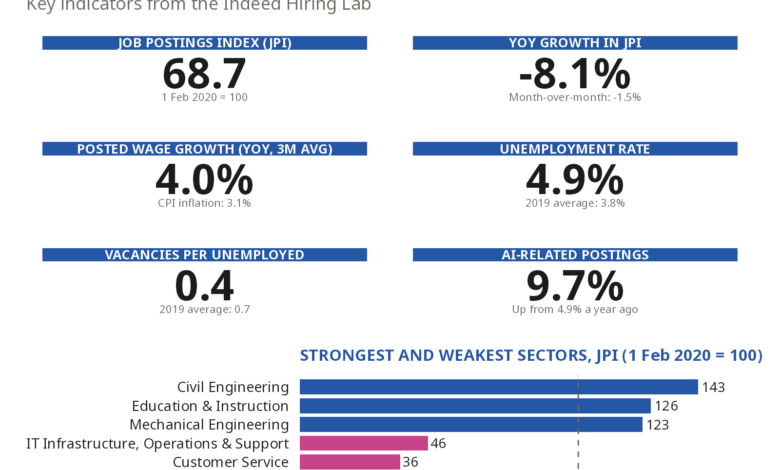
The data reveals a structural shift in hiring behaviour. The Job Postings Index (JPI), a key indicator of labour demand, stands at 69, indicating that current hiring activity is significantly depressed compared to early 2020 levels. Specifically, job postings remain 31% below their pre-pandemic baseline. This is not an across-the-board collapse; rather, it is a sectoral realignment. Only six of the 49 tracked industry categories have recovered to above-baseline posting levels. These sectors are dominated by engineering disciplines—civil, mechanical, electrical, and industrial—alongside education and social science. Conversely, industries such as IT infrastructure, customer service, and nursing remain the furthest below their pre-pandemic norms, suggesting persistent structural challenges in these workforce-heavy fields.
For workers, the most immediate concern is the erosion of purchasing power. Posted wages rose 4.0% over the year ending August 2026. While this figure appears modestly positive, it has essentially flatlined over the past six months. The critical metric is the gap between wage growth and inflation, which has narrowed to just 0.9 percentage points as inflation crept higher to 3.1%. Since mid-2023, advertised wages have grown more quickly than prices, but that advantage has largely dissipated. For the average household, this means that while nominal pay is rising, the real value of that income is barely keeping pace with the cost of living, if at all.
The impact on younger demographics is particularly acute. While the overall unemployment rate holds at a relatively low 4.9% for the three months to July, the picture for those aged 16 to 24 is stark. Youth unemployment has climbed steadily over the past four years to reach 16.4%, a joint-high for almost 12 years. This represents a sharp increase from the 9.3% recorded in mid-2022. The vacancy-to-unemployment ratio, which stands at 0.4, indicates that there is now less than one available job vacancy for every two unemployed workers, a tight market that offers little cushion for new entrants to the workforce.
Regional disparities further complicate the national narrative. Labour demand is no longer evenly distributed across the UK. Northern Ireland currently holds the highest JPI at 110, the only region to remain above its pre-pandemic baseline. In contrast, the South East and London exhibit the lowest levels of hiring activity, with JPIs of 57 and 65 respectively. At the city level, Middlesbrough leads with a JPI of 110, while Reading, Slough, and Brighton sit at the bottom of the tracked list. This geographic divergence suggests that the “national” labour market is less a uniform entity and more a collection of distinct local economies responding to different industrial pressures.
As the Bank of England considers its policy stance, the central dilemma is clear. The labour market is not overheating, which might argue for lower rates to stimulate demand, yet inflation remains above target and real wage growth is stagnant. The data points to an economy in a low-hire, low-fire mode, where employers are cautious and workers are increasingly priced out of the market. With youth unemployment at historic highs and the gap between wages and prices nearly closed, the next few months will test whether monetary policy can provide the nudge needed to reinvigorate genuine hiring without reigniting price pressures.