
The Demand Crunch
Both firms confirm a structural shortage in AI compute resources. CoreWeave states that qualified demand is currently ten times its available capacity through the end of 2027. To manage this scarcity and improve margins, CoreWeave implemented pricing increases of approximately 25% in July, followed by a further 10% increase later in the quarter. These adjustments contributed to an adjusted operating margin of 10%, a milestone the company achieved one quarter ahead of its internal plan.
Nebius similarly reports that demand exceeds supply. CEO Arkady Volozh noted that prepayments for third-quarter agreements covered more than 100% of the associated capital expenditure (capex). However, the company’s operating cash flow remained negative during the period. Nebius also saw significant price appreciation, with GPU-hour prices rising more than 20% from the second quarter. This pricing power was bolstered by new multi-year contracts signed with major technology firms, including Databricks, Datadog, and Snowflake.
Financial Divergence: Debt vs. Cash

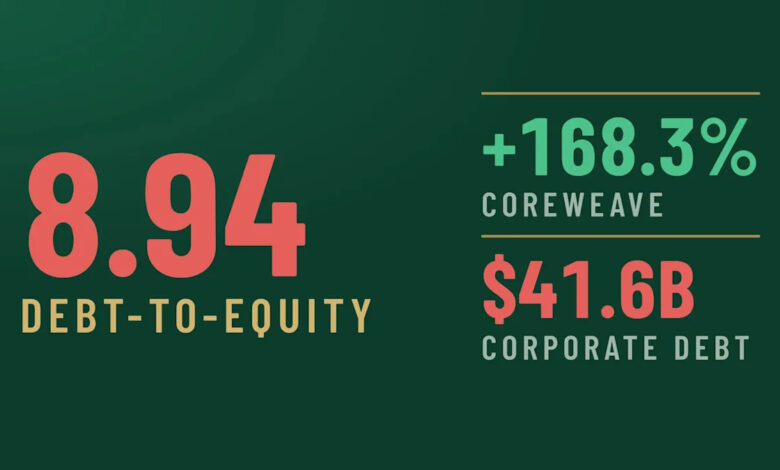
The critical difference between the two companies lies in how they finance their growth. CoreWeave has aggressively leveraged its balance sheet, carrying $41.6 billion in corporate debt. This heavy leverage directly impacts its bottom line; net interest expense of $846 million was a primary driver of a $709 million GAAP net loss for the quarter, despite strong revenue growth.
CoreWeave’s revenue reached $3.66 billion, a 168.3% year-over-year increase. While the top-line growth is substantial, the cost of capital remains a significant headwind. In contrast, Nebius posted revenue of $980.8 million, surging 571.3%. However, investors have scrutinized the quality of this revenue. Approximately $325 million of Nebius’s total revenue came from a non-recurring, asset-light deal, which inflates the headline figure relative to the recurring business base.
Operational Risks and Market Reaction
Nebius faces specific operational hurdles that have tempered investor enthusiasm. Delays in colocation facilities in New Jersey have pushed the company’s 2026 revenue outlook to the low end of its $3.0 billion to $3.4 billion guidance range. Consequently, Nebius stock experienced a sharp decline following its earnings release, with the CEO explicitly warning of revenue delays. The market appears to be penalizing the company for execution risks and the non-recurring nature of a significant portion of its earnings.

Conversely, CoreWeave’s results sparked a broader rally in AI cloud stocks, lifting peers such as Nvidia. The market interpreted CoreWeave’s ability to maintain high margins despite heavy debt loads as a sign that the AI infrastructure bubble fears were overstated. The company’s strategy of using debt to fund rapid capacity expansion has, for now, been rewarded by investors who prioritize growth speed over balance sheet conservatism.
Strategic Implications
The divergence between CoreWeave and Nebius illustrates a key trade-off in the AI infrastructure sector. CoreWeave’s model allows for rapid scaling and immediate capacity deployment, supported by a massive debt load that increases financial risk but accelerates market share capture. Nebius’s model, while currently generating higher percentage growth in revenue, is constrained by physical infrastructure delays and a reliance on prepayments to cover capex. The negative operating cash flow at Nebius suggests that while customer demand is strong, the company is still in a heavy investment phase where cash outflows exceed inflows from operations.
For investors and analysts, the distinction is clear: CoreWeave is betting on the durability of AI demand to service its $41.6 billion debt, while Nebius is navigating a transition from asset-light deals to a more sustainable, recurring revenue model. The next few quarters will be critical in determining whether Nebius can overcome its New Jersey delays and whether CoreWeave’s debt burden remains manageable as interest rates and market conditions evolve.