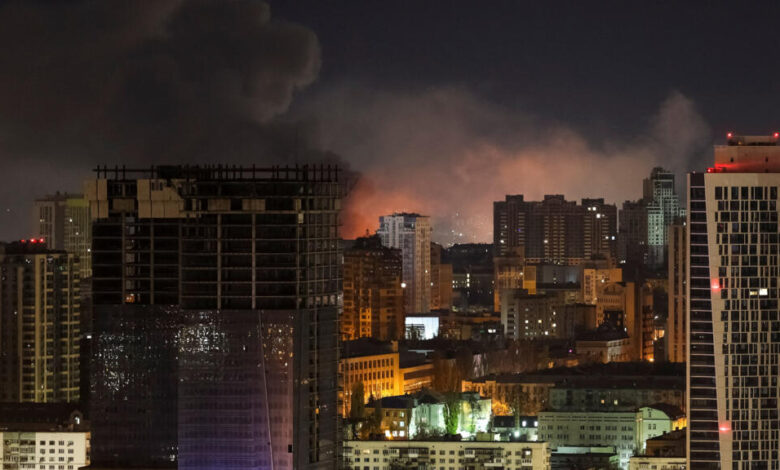
Impact on Kyiv Infrastructure and Casualties
At least three people were killed and 15 injured in Kyiv, according to Mayor Vitali Klitschko. However, Prime Minister Sergii Koretskyi reported a higher toll for the capital, stating that six people were killed in Kyiv alone. In total, Prime Minister Koretskyi announced that eight people were killed and 28 wounded across Ukraine in the overnight attacks. The discrepancy in casualty figures between local and national authorities highlights the ongoing challenges in immediate post-strike verification.
The physical damage to Kyiv’s critical transportation network is severe. Three bridges spanning the Dnipro River were hit by ballistic missiles: the Podilsko-Voskresensky bridge, the Darnytskyi bridge, and the Southern bridge. Mayor Klitschko confirmed that the Podilsko-Voskresensky and Darnytskyi bridges had sustained damage, with traffic from the right bank to the left bank currently closed on the former. The status of the Southern bridge’s structural integrity was not explicitly clarified in initial reports, though it was confirmed as a target. These strikes add to the disruption caused by earlier retaliatory strikes on bridges this week, forcing the mayor to urge residents to avoid private car travel into the city unless absolutely necessary.
Beyond transportation, the strikes targeted the energy sector. Deputy Energy Minister Artem Nekrasov stated that Ukraine’s nuclear power plants were forced to reduce generation following Russian strikes on energy infrastructure. Power plants and electricity transmission and distribution substations were hit, causing widespread outages in Kyiv and ten other regions, including Vinnytsia, Dnipropetrovsk, Donetsk, Zaporizhzhia, Kirovohrad, Odesa, Kharkiv, Kherson, Cherkasy, and Chernihiv. This marks a concerted effort to strain Ukraine’s civilian resilience and industrial capacity simultaneously.
Wider Campaign and Strategic Context
The attack was not limited to the capital. In western Ukraine, two people were killed and four wounded in a Russian strike on the Sknyliv train station in Lviv. In Kharkiv, four people were injured after drones struck a hospital and a residential district. The Russian Defense Ministry claimed the strikes targeted “enterprises of Ukraine’s military-industrial complex, warehouses, energy facilities, transportation and port infrastructure, and naval vessels,” using “high-precision land-based, naval, and air-based weapons.”
This offensive follows directly from President Vladimir Putin’s vow of “painful” retaliation after Ukrainian forces damaged the Crimean Bridge earlier this week. The bridge, which links mainland Russia to the annexed Crimean Peninsula, is a critical logistical artery for Russian forces and a symbolic asset for the Kremlin. Ukrainian President Volodymyr Zelensky described the operation to weaken the bridge as having been in the planning stages for weeks, representing a tactical and symbolic blow to Moscow’s logistics.
The scale of the Russian response—combining ballistic missiles with a massive drone swarm—suggests a shift toward overwhelming Ukrainian air defenses and targeting systemic vulnerabilities rather than isolated tactical objectives. The simultaneous hit on energy grids and transport hubs aims to degrade Ukraine’s operational readiness and civilian stability. Meanwhile, Ukrainian Unmanned Systems Forces reported hitting 40 Russian oil facilities and defense industry targets over the past 50 days, including a chemical plant in Smolensk region struck twice, indicating a continuing pattern of deep-strike exchanges.
Internationally, the escalation occurs against a backdrop of diplomatic friction. Russian Deputy Foreign Minister Sergei Ryabkov stated that Ukraine joining NATO, even in a “quasi-membership” form, is unacceptable. Concurrently, thousands of European troops are participating in the “Koalicja 26.2” military exercise in southeastern Poland, a non-NATO initiative led by France and the UK to test deployment plans for a potential postwar mission in Ukraine. This exercise serves as a signal of European military commitment, contrasting with Russia’s intensified kinetic pressure.
The immediate aftermath sees ongoing efforts to secure areas where debris may have fallen, including a reported incident in Poland near the Ukrainian border where an unknown object was said to have fallen, though this remains under investigation. For now, the focus remains on the humanitarian impact of the energy blackouts and the repair of the damaged bridges, which are vital for the movement of both civilians and military logistics within the capital.