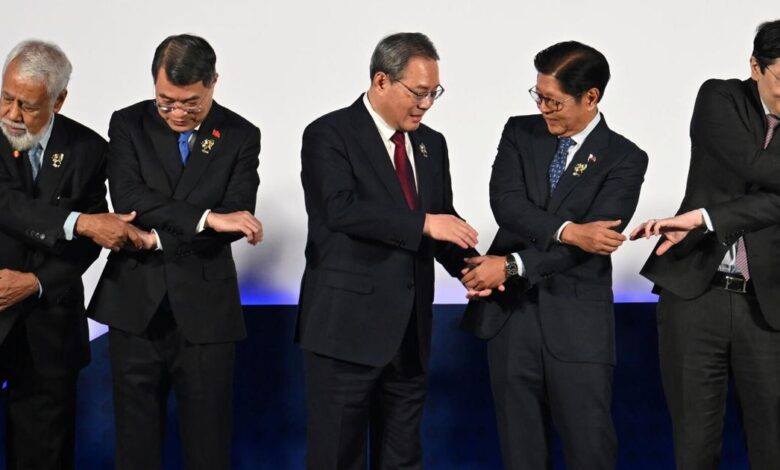
The opening of the summit was marked by a formal group photograph that captured the physical proximity of key regional leaders. From left to right, the image featured East Timor’s Prime Minister Xanana Gusmao, Vietnamese Prime Minister Le Minh Hung, China’s Premier Li Qiang, Philippine President Ferdinand Marcos, and Singapore Prime Minister Lawrence Wong. The leaders joined hands in a display of unity during this high-stakes diplomatic occasion.
The presence of these specific heads of state and government underscores the strategic importance of the Manila summit. The inclusion of China’s Premier Li Qiang signals Beijing’s continued engagement with the ASEAN framework, a critical channel for trade and security dialogues. Simultaneously, the participation of Philippine President Ferdinand Marcos highlights the host nation’s role in facilitating these discussions, given the Philippines’ status as the current chair or a pivotal participant in the ASEAN cycle. The grouping also includes Vietnam’s Prime Minister Le Minh Hung and Singapore’s Prime Minister Lawrence Wong, representing diverse economic structures within the region, from manufacturing heavyweights to financial hubs.
While the provided sources focus on the ceremonial and logistical aspects of the summit’s opening, the meeting itself serves as the primary venue for negotiating trade protocols, investment frameworks, and geopolitical stability in Southeast Asia. The ASEAN-China relationship is a cornerstone of the regional economy, with China serving as a major trading partner for all ASEAN members. The summit’s timing in late November 2026 places it within a period often used for setting bilateral and multilateral agendas for the coming year.
The visual record of the summit, specifically the group photo, serves as a concrete indicator of diplomatic continuity. The act of joining hands is a standard diplomatic convention, symbolizing cooperation and mutual respect among the participating nations. In the context of the 49th ASEAN Summit, this gesture reinforces the bloc’s commitment to maintaining open channels of communication with China, despite broader geopolitical tensions that frequently characterize international relations.
The summit’s proceedings are expected to address a range of issues, from supply chain resilience to digital economy standards, although the specific policy outcomes are not detailed in the available source material. The gathering of leaders such as Gusmao, Le Minh Hung, Li Qiang, Marcos, and Wong suggests a comprehensive approach to regional stability, involving both established economic powers and developing nations like East Timor.

As the summit progresses, the focus will likely shift from ceremonial displays to substantive negotiations. The Manila venue provides a neutral yet significant ground for these discussions, leveraging the host country’s diplomatic influence. The outcome of the 29th ASEAN-China Summit will have ripple effects across Southeast Asia, influencing trade flows, investment decisions, and regional security architectures. The next phase of the summit will determine whether the diplomatic goodwill displayed in the opening photograph translates into concrete economic agreements and policy alignments.
The participation of these five leaders in the group photo highlights the interconnectedness of the region. Their joint appearance in Manila on November 16, 2026, marks a moment of collective diplomatic action, aiming to navigate the complexities of the global economic landscape through regional cooperation.