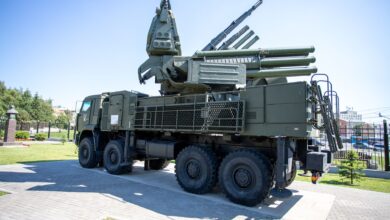
Following the collapse, Russia’s Ministry of Transport announced a “temporary suspension” of all traffic on the bridge, although rail services were reportedly resumed shortly thereafter. Russian authorities launched a criminal investigation, characterizing the incident as a “terrorist attack.” It was only after this official announcement that the Security Service of Ukraine (SBU) confirmed its responsibility for the strike. The SBU described the operation as a multi-phase effort lasting approximately one month, which began with the systematic neutralization of Russian air defense systems before the direct attack was executed. Ukrainian sources indicated that the strike employed a variety of domestically produced weapons, including various drones, FP-5 Flamingo missiles, and R-360 Neptun missiles. While some Russian military bloggers alleged the involvement of Western allies or equipment, Ukraine has not confirmed these claims, and reports from *The Times* citing Ukrainian military sources suggest the attack was conducted without reliance on SpaceX’s Starlink satellite network, though this remains unverified.
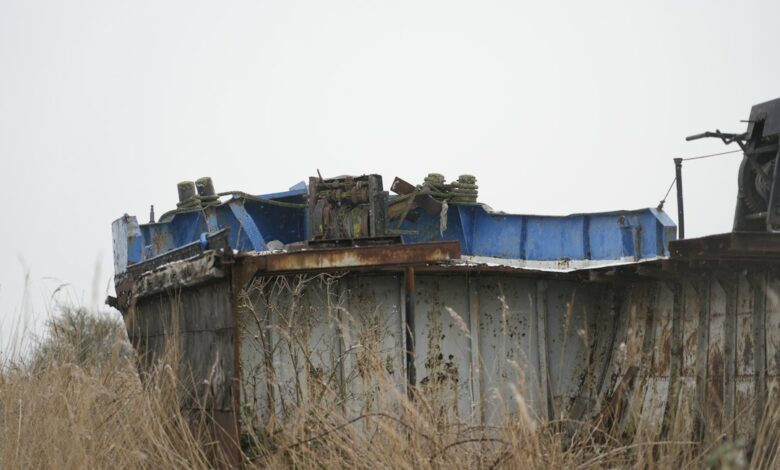
The strategic significance of the Kerch Bridge extends beyond its symbolic value as a flagship project of Russian President Vladimir Putin. Completed four years after the 2014 annexation of Crimea—an act deemed illegal under international law—the bridge has been a target of Ukrainian operations since the full-scale invasion began in 2022. Previous incidents include an explosion in October 2022 that caused months of traffic restrictions and a strike in June 2025 reported by the SBU to have destroyed an underwater support structure. However, the current collapse represents a qualitative shift in the disruption of transport capabilities. The Kerch Strait navigational channel, which is only 120 meters wide and 3 to 5 meters deep, is now completely blocked by debris from the collapsed structure.
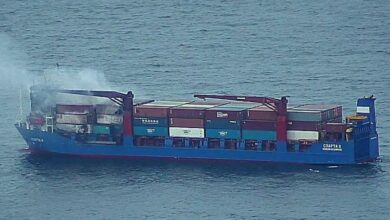
This blockage has immediate operational consequences for maritime logistics. Mychajlo Hontschar of the Ukrainian Center for Global Studies “Strategy XXI” notes that the strait’s shallow depth and narrow width, maintained by dredging since the 19th century, are now rendered impassable. Consequently, river-sea vessels operating in the Sea of Azov, the Don, and the Volga basins are trapped, unable to exit to the Black Sea. Similarly, boats and small ships belonging to the Black Sea Fleet and the Caspian flotilla based in Novorossiysk are isolated from the open sea. This maritime blockade exacerbates the pressure on overland supply routes, which are now compromised by the bridge’s damage.
Ukrainian military experts argue that the strike targets a critical vulnerability in Russian logistics that cannot be easily mitigated. Oleksandr Kovalenko, an expert with the Information Resistance Group, states that Russia has no alternative land connection to replace the Kerch Bridge. He warns that this disruption could lead to resource shortages for Russian forces in Crimea, potentially degrading their offensive and defensive capabilities. “If there is a resource shortage during attacks or in defense, then either the attacks or the defense will fail,” Kovalenko told DW. He further noted that Crimea serves as a launchpad for numerous military operations, including kamikaze drones targeting Odesa, Mykolaiv, and the Kherson region, as well as the deployment of Iskander-M ballistic missiles, Zircon and Oniks guided missiles, and glide bombs. The inability to easily transport these heavy munitions and support equipment across the strait could significantly reduce the frequency and intensity of such attacks.
In contrast, pro-Kremlin narratives have downplayed the military impact. Olga Kurlayeva, described by the *Dva Mayora* Telegram channel as the “Deputy President of the Republic of Crimea,” characterized the bridge as a “purely civilian structure,” suggesting it plays a minor role in military logistics. However, independent analysis contradicts this view, pointing to the systematic nature of Ukrainian strikes on Russian infrastructure, including the R-80 highway through occupied territories in Donetsk, Zaporizhzhia, and Kherson. The convergence of these attacks suggests a coordinated strategy to degrade Russian logistical networks.
The political and psychological implications of the strike are also substantial. President Volodymyr Zelenskyy framed the operation as a direct response to Russian attacks on Ukrainian infrastructure, stating, “The war always returns to where it began.” For President Putin, the destruction of a prestigious national project comes at a sensitive time, coinciding with planned meetings with Chinese President Xi Jinping and US President Donald Trump in Shenzhen. Russian spokesperson Dmitry Peskov has vowed to rebuild the bridge, promising it will be “even better than before.” However, engineering assessments suggest this is unlikely to happen quickly. Andrii Korezkyj of the Kyiv University of Transportation estimates that reconstruction would take between one and a half and three years. He added that Ukrainian forces are now capable of striking repair teams and floating cranes, making the installation of pre-assembled arches a highly challenging task under current combat conditions. Even pro-Kremlin commentators on the Rybar Telegram channel acknowledge the difficulty of rebuilding under such sustained threat.
The collapse of the Kerch Bridge stands as a tangible marker of the shifting dynamics of the conflict, where infrastructure warfare is increasingly used to undermine operational efficiency and strategic prestige. While Russian authorities work to restore limited rail traffic and manage the maritime blockade, the long-term impact on Russian military logistics in Crimea remains a significant uncertainty. The next confirmed development will likely involve the assessment of repair efforts and any subsequent Ukrainian operations targeting remaining logistical nodes in the region.