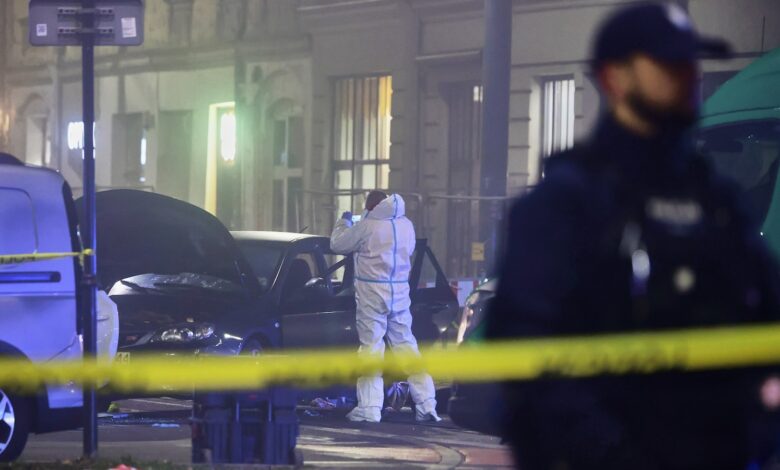
The shooting began around 3:00 p.m. local time when a black Subaru entered the historic Main Square (Rynek Glowny) from Sławkowska Street. Witnesses and police reports indicate the 24-year-old suspect, identified as Michał O., was wearing military-style fatigues and a bullet-resistant vest. He fired an AR-15-style rifle at pedestrians from the moving vehicle. A tram driver reported that the gunman fired at his vehicle, shattering the driver’s window, although no passengers were injured. Police pursued the suspect south along Grodzka Street and apprehended him approximately one kilometer from the square. During the confrontation, two police officers were wounded; one remains in a coma, while the other has regained consciousness. Authorities confirmed the suspect was not a member of the Polish Army or the Territorial Defense Forces, despite earlier confusion regarding his military affiliation.
Police confirmed that six individuals were killed in the square: four women and two men. Among the victims was a British national, while three women and one man were Polish citizens. A seventh victim, a woman from an unidentified country, was also killed in the square. In addition to the six fatalities in the square, police discovered three bodies at the suspect’s apartment in Ostrowiec Świętokrzyski, a town approximately 150 kilometers northeast of Krakow. Authorities identified these victims as the suspect’s father, mother, and sister. Police stated that the family members likely died from gunshot wounds and that several firearms, including a dozen legally owned by the father, were seized from the residence. The suspect and his father were reportedly members of a shooting club.
Investigations into the motive are ongoing, with Interior Minister Marcin Kierwiński stating that evidence indicates the suspect held “very radical views” and was “fascinated by far-right ideologies.” Prime Minister Tusk labeled the attack an act of “far-right terrorism,” though authorities have not yet formally established a specific political motive. The suspect, who has no previous criminal record according to Polish media reports, remains hospitalized in critical condition under police custody following multiple surgical operations. Authorities stated they are not seeking additional suspects.
The attack resulted in at least 15 to 16 injuries, including the two police officers. Among the wounded are citizens of the United Kingdom, Austria, Germany, Portugal, and Russia. The Krakow Carriage Driver’s Association reported that several horse-drawn carriage drivers were seriously injured, and the animal welfare organization OTOZ Animals confirmed that two horses were shot, one of which was wounded in the leg.
The legal proceedings will focus on the classification of the crime under Polish law. The designation of the act as a “terrorist offence” by the National Prosecutor’s Office carries significant procedural implications, potentially invoking specific statutory frameworks for counter-terrorism investigations and penalties. While the suspect is currently detained on the basis of the attack, formal charges have not yet been announced. The presumption of innocence remains in effect until a court renders a judgment. The case is expected to proceed through the standard criminal investigation phase, with the suspect remaining in custody while medical stability is assessed.
National and religious leaders have responded to the tragedy. Cardinal Grzegorz Rys of Krakow, whose residence is located near the square, urged Poles to stand together, stating, “We do not want to be, we cannot be, and we are simply unable to be indifferent at a time like this.” Archbishop Tadeusz Wojda, president of the Polish bishops’ conference, expressed spiritual solidarity with the victims. Krakow Mayor Łukasz Gibała declared a local mourning period through November 11, while flags across Poland were flown at half-mast. Mourners gathered in the Main Square, which remains partially sealed off for forensic investigation, to leave candles and floral tributes.
The next formal step in the legal process will be the issuance of an indictment by the Krakow Prosecutor’s Office. Given the suspect’s critical medical condition, the timeline for trial proceedings may be subject to delay until he is fit to stand trial. The case will also draw attention to firearms regulations and the handling of radicalized individuals within Polish society.