
In the Sunday elections, held in the northeastern coastal state of Mecklenburg-Western Pomerania and the capital, Berlin, the CDU faced a dual defeat. In Mecklenburg-Western Pomerania, the party garnered approximately 4.9% of the vote, falling just short of the 5% threshold required for parliamentary representation. This result confirmed that the party had been voted out of the state legislature entirely. In Berlin, the CDU dropped to second place, securing roughly 20% of the vote, a decline of nearly a third from its previous share. It was left behind by the far-left Die Linke, which recorded its best-ever result with 25.7% of the vote.
The far-right Alternative for Germany (AfD) made significant gains in both states. In Mecklenburg-Western Pomerania, the AfD finished as the strongest party with 38.2% of the vote, more than doubling its share from the 2021 state election. In Berlin, the party secured 16.3%, placing it third behind Die Linke and the CDU. These results mark the third time this month the AfD has emerged as the leading party in a regional vote, following a strong showing in Saxony-Anhalt two weeks prior.

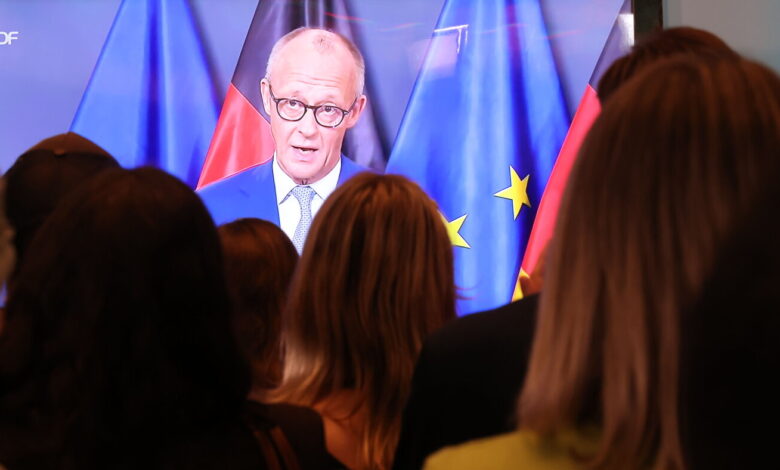
Merz, who had been expected to travel to New York for the United Nations General Assembly, addressed the media from CDU headquarters in Berlin hours after polls closed. He described the outcome in Mecklenburg-Western Pomerania as a “disaster” for the political center. However, he firmly rejected speculation regarding his resignation, stating that no “personnel questions” had been raised during party leadership meetings on Sunday or Monday.
“These reforms are the antidote to the poison of authoritarianism,” Merz said, referring to his federal agenda of tax, healthcare, and pension reforms. “I would even go so far as to say that these reforms are the antidote to the poison of authoritarianism, which is penetrating ever deeper into our society.”
He acknowledged that the CDU “no longer has satisfactory answers to too many questions” and admitted the party needed to improve its profile. Merz emphasized that his coalition with the Social Democratic Party (SPD) remains focused on making the country “fit for the coming years,” arguing that governing requires “backbone, steadfastness and patience” rather than the “easy solutions” suggested by extremists.
Reactions from opposing parties were sharp. AfD co-leader Alice Weidel told public broadcasters that Merz was “dragging the party down” and declared that the CDU’s containment strategy of refusing to cooperate with the AfD had failed. AfD co-leader Tino Chrupalla mocked Merz, calling on him to resign after what he termed a “very clear result” from voters. In Berlin, Die Linke leader Elif Eralp, who is poised to become the first Left Party mayor of the city if coalition talks succeed, said the party’s vision was an “affordable Berlin where everyone can lead a good life in dignity.”

Both Berlin and Mecklenburg-Western Pomerania are among Germany’s 16 federal states, each with its own parliament and government. While Berlin is a major political center, Mecklenburg-Western Pomerania has a smaller electorate of approximately 1.3 million voters, compared to 2.5 million in Berlin. In Mecklenburg-Western Pomerania, the incumbent SPD state governor, Manuela Schwesig, finished second with 35% of the vote. Despite the AfD’s victory, the party is unlikely to form a government due to a “firewall” of non-cooperation agreed upon by other major parties. Schwesig is expected to seek a coalition with the SPD, the Left Party, and the Greens to remain in office.
The next major electoral step for the federal government remains the national election scheduled for 2029. For now, Merz’s administration will continue its legislative program while facing sustained pressure from both the far right and the left, as well as internal party demands for a strategic overhaul.