
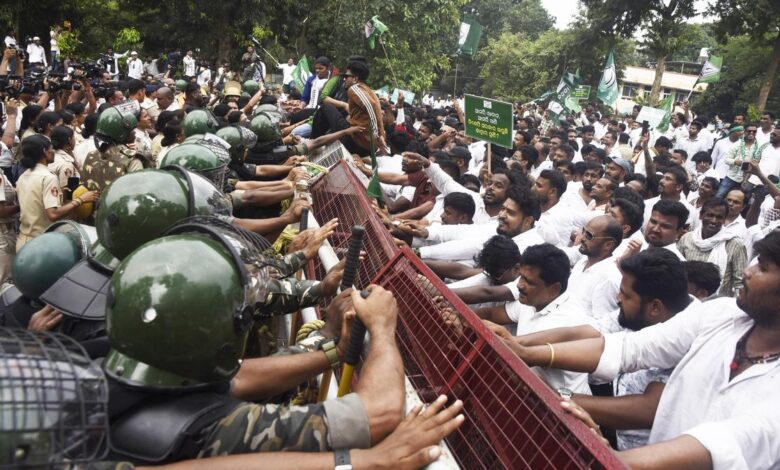
Escalation in Bhubaneswar
The decision to call for a state-wide shutdown comes in the aftermath of violent clashes between protesters and law enforcement personnel in Bhubaneswar, the capital of Odisha. These confrontations have underscored the depth of opposition to the recent legislative changes. While the specific chronological details of the clashes were not fully detailed in the initial reports, the incident is cited as a key trigger for the broader mobilization by the opposition coalition. The disruption of public order in the state capital has raised concerns among civilian populations regarding the safety and economic impact of prolonged protests.
The INDIA bloc, a coalition of major opposition parties in India, has positioned itself as the primary voice against the current government’s mining policies in the region. By organizing a bandh, the coalition is leveraging its organizational reach to exert pressure on the ruling administration. A bandh typically involves the closure of markets, shops, schools, and public transport, effectively halting the state’s economic activity for a day. This tactic serves both as a form of non-violent resistance and as a demonstration of the opposition’s capacity to mobilize mass support.
Focus on the MMDR Act
At the center of the dispute is the Mineral (Amendment) and Regulatory (MMDR) Act. The opposition argues that the new regulations negatively impact local interests and require immediate revision or repeal. The specific grievances include concerns over the management and distribution of mining rights, which are critical to the economic landscape of Odisha, a state with substantial mineral reserves. The bloc’s demand for repeal suggests that they view the current legal framework as fundamentally flawed rather than subject to minor amendments.
The political dynamics in Odisha have been increasingly polarized in recent months. The announcement of the bandh indicates that dialogue and negotiation have not yet resolved the core disagreements between the opposition and the state or central government regarding mining policies. The incident in Bhubaneswar, where police and protesters clashed, suggests that the frustration among the opposition base and their supporters has reached a level where peaceful protest is being met with significant resistance or has turned volatile.
For citizens of Odisha, the impending bandh presents immediate practical challenges. The closure of public services and businesses is expected to disrupt daily life, commute patterns, and supply chains. Local authorities are likely to deploy additional security forces to maintain order, a move that could potentially lead to further confrontations if the protest turns violent. The situation highlights the broader challenges of balancing regulatory reform with public consent and social stability in resource-rich states.
Political Implications
The INDIA bloc’s strategy reflects a broader pattern of using mass mobilization to challenge government policies in states where they do not hold power. The focus on the mining law is particularly significant given the economic importance of the sector to Odisha’s revenue and employment. By linking the bandh to the MMDR Act, the opposition is framing the issue not merely as a local grievance but as a matter of national policy reform.
The outcome of the October 8 bandh will be closely watched by political analysts and government officials alike. If the protests remain largely peaceful but widely attended, it may strengthen the opposition’s negotiating position. Conversely, if the bandh is met with heavy-handed policing or if significant violence erupts, it could complicate the political narrative and potentially alienate moderate voters. The ruling administration is expected to respond with a combination of security measures and political communication to address the demands while maintaining public order.
As the date approaches, the focus will shift to the readiness of both the protesters and the law enforcement agencies. The coming days will determine whether the dispute over the mining law remains a political debate or escalates into a more serious social unrest. The INDIA bloc’s willingness to call for a state-wide shutdown signals their commitment to the cause, but the ultimate success of the movement will depend on the scale of participation and the government’s response to the demands for repeal.
The next formal step in this political process will be the execution of the bandh on October 8. Observers will monitor the extent of participation, the level of police deployment, and any official statements from the government regarding the MMDR Act. The resolution of this conflict will have implications for future mining policies in Odisha and potentially for similar legislative challenges in other states.