Scale and Composition of the Attack
The offensive was a multi-domain operation involving missiles, drones, and decoys. In addition to the Kh-22/32 missiles, Russian forces launched Iskander-M/KN-23 ballistic missiles from the Voronezh and Rostov regions, as well as four Kalibr sea-based cruise missiles from the port of Novorossiysk. The aerial component was dominated by unmanned systems: 332 Shahed-type strike UAVs (31 of which were jet-powered), S-8000 Banderol drone missiles, Gerbera drones, and Parody decoy UAVs were deployed from various directions.
Ukrainian air defense units, including anti-aircraft missile batteries, electronic warfare assets, and mobile fire groups, reported neutralizing 293 aerial targets between 6:00 p.m. on October 16 and the morning of October 17. This figure includes the interception of all four Kalibr missiles and 289 UAVs. While specific interception counts for the Iskander and Kh-22/32 missiles were not detailed in the immediate reports, impacts were recorded at 22 locations across Ukraine, with debris from downed assets confirmed at three sites. The attack remained ongoing at the time of initial reporting, with several drones still in Ukrainian airspace.
The Kh-22/32: Capability and Tactical Role
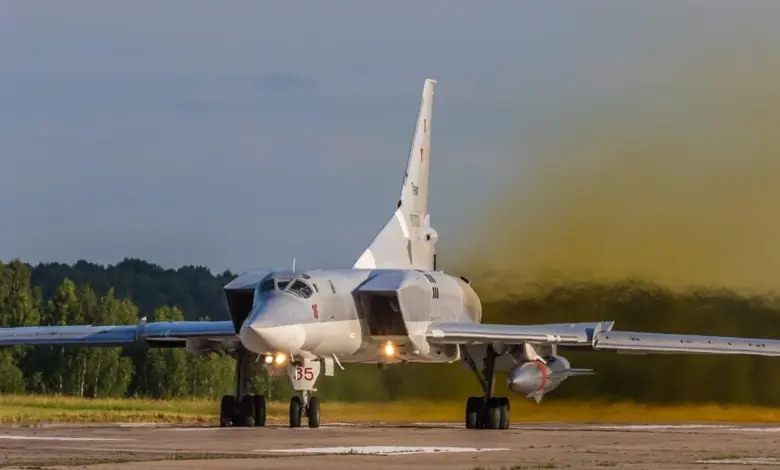
The Kh-32, developed by the Raduga State Machine Building Design Bureau and entered into service in 2018, is a major upgrade to the Kh-22, a missile that has been in Soviet and Russian service since the 1960s. Both systems are launched from Tu-22M3 “Backfire” bombers. The Kh-32 was designed to address the Kh-22’s low resistance to electronic countermeasures. It boasts a range of up to 1,000 kilometers and a speed between 3.5 and 4.6 Mach.
Tactically, these missiles present a significant challenge to air defense systems due to their ability to dive toward targets at a steep angle. This maneuver combines the characteristics of a cruise missile with those of a ballistic weapon, complicating interception trajectories. The warhead weighs up to 700 kilograms (9A22 M/MK variant). While the Kh-22 was originally designed to strike large naval targets like aircraft carriers, its use against land-based infrastructure in Ukraine has demonstrated its continued relevance as a precision strike tool, albeit one with inherent limitations in accuracy compared to newer systems.
Strategic Context: Bomber Fleet Attrition
The re-deployment of these missiles occurs against a backdrop of significant strain on Russia’s long-range bomber force. Ukrainian Defense Express estimates that Russia may have lost more than 70% of its combat-ready Tu-22M3s since the start of the full-scale invasion. Moscow is believed to have entered the war with roughly 33 to 41 mission-capable aircraft. Recent Ukrainian operations, including “Operation Spiderweb” in June 2025, reportedly destroyed or heavily damaged a dozen Tu-22M3s in a coordinated campaign, with satellite imagery confirming damage at bases such as Dyagilevo, Soltsy, Olenya, and Belaya.
Additionally, three aircraft were lost in training crashes in Russia’s Irkutsk region, with the most recent incident occurring on June 15. A further loss was recorded in April 2024 when a Ukrainian S-200 missile shot down a bomber over the Stavropol region. With no new Tu-22 variants built since 1993, Russia faces acute spare-parts shortages, meaning even minor damage can render an airframe permanently inoperable. Estimates suggest that only nine fully operational Tu-22M3s may remain, a drastic reduction from the pre-war inventory.
Operational Implications
Despite these losses, the October 17 strike demonstrates that Russia retains the capability to project power at long range using high-speed cruise missiles. The Tu-22M3 platform, particularly in its modernized Tu-22M3M variant, offers a 24-ton payload capacity and a claimed top speed of 2,000 to 2,300 km/h. However, the platform lacks the low-observable features necessary to routinely penetrate modern air-defense networks. Its operational doctrine relies on speed and standoff launching, allowing bombers to release weapons and turn away before engaging with enemy fighters or surface-to-air missiles.
For Ukrainian defense planners, the return of Kh-22/32 missiles underscores the need for layered air defense capabilities capable of engaging high-velocity, high-altitude targets. The combination of ballistic missiles, cruise missiles, and massive drone swarms continues to stress Ukrainian air defense resources, forcing a complex allocation of interceptors across multiple threat vectors. The strategic significance of this development lies in the proof that despite the “hollowing out” of the bomber fleet, the remaining assets are still being employed in high-intensity operations, targeting critical infrastructure and military assets across the country.
The next critical observation point will be whether Russia continues to integrate Kh-22/32 launches with kinetic strikes on the Russian mainland, which would indicate a shift toward reciprocal long-range engagements. Furthermore, the sustainability of such attacks will depend on Russia’s ability to repair its remaining bomber fleet and manage the logistical constraints of its aging aerospace inventory.