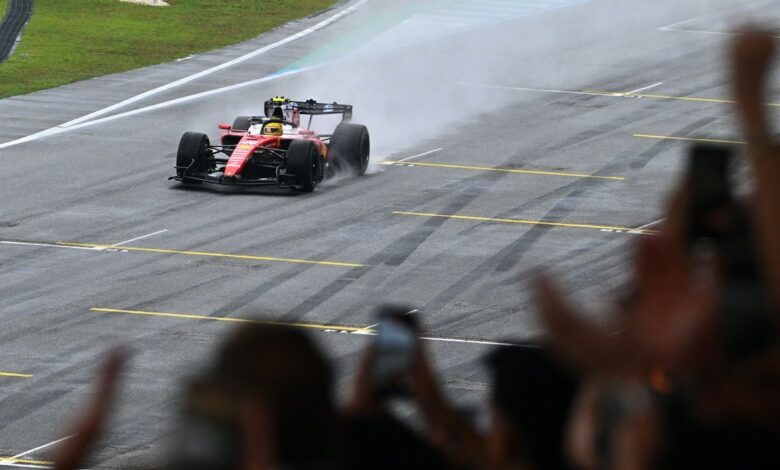
Russell, who currently trails his Mercedes team-mate Kimi Antonelli by 84 points in the drivers’ standings, explained the logistical constraints driving the decision. “You get a limit of four engines a season, so six races on each, and we have seven races to the end,” Russell said. “So I will be taking another penalty, so yeah it’s pretty relentless at the moment.” The original plan was to utilize the older engine until a planned upgrade was available for the United States Grand Prix in Austin. However, the failure in Malaysia eliminated the option to revert to a previous power unit, necessitating an immediate replacement.
The Briton acknowledged the difficulty of the circuit choice, noting that Marina Bay is one of the most challenging tracks on the calendar for overtaking. “I knew I was going to have a penalty,” he admitted. “The plan was always to go in Austin, and obviously Singapore is the second hardest track to overtake on the calendars. So you would never choose to do it here.” Despite the setback, Russell stated that the team chose to accept the penalty rather than risk the reliability of an older, degraded engine over the final seven races. Antonelli is also expected to face a similar back-of-grid start in the future when his own engine upgrade is introduced, following a penalty at the Italian Grand Prix from which he secured a victory starting 19th.
In other developments, four-time world champion Max Verstappen expressed determination to finally win the Singapore Grand Prix, a race he has not claimed in nine appearances. The Red Bull driver has finished second on three occasions at the Marina Bay Street Circuit but has yet to take pole position or victory. “I have unfinished business here,” Verstappen said, acknowledging that his team has historically struggled with the track’s characteristic low-speed corners and bumpy kerbs. He noted that while this year’s car is more competitive in low-speed sections, the team continues to face challenges with the circuit’s surface irregularities.
Meanwhile, seven-time world champion Lewis Hamilton observed a growing divide in attitudes toward wet-weather racing between veteran drivers and the younger generation. Following the significant rain delay and subsequent use of intermediate tyres in Malaysia, Hamilton commented that newer drivers are becoming “more and more cautious.” “Us old-school drivers are like, ‘Let’s get racing’, and more of the youngsters are like, ‘Let’s not race’,” Hamilton said. He emphasized his personal preference for driving in extreme conditions, describing it as an area where drivers can make a significant difference, while noting that the regulatory environment and modern tire development have altered the nature of wet-weather competition compared to previous eras.
Singapore Grand Prix organizers have also indicated that on-track entertainment may be restricted if air quality conditions worsen due to regional haze. The FIA has outlined measures to ensure spectator and driver safety should visibility drop below acceptable thresholds. The race weekend serves as a critical juncture in the championship, with both Mercedes and Red Bull looking to capitalize on their respective strategic positions as the season enters its final stages.