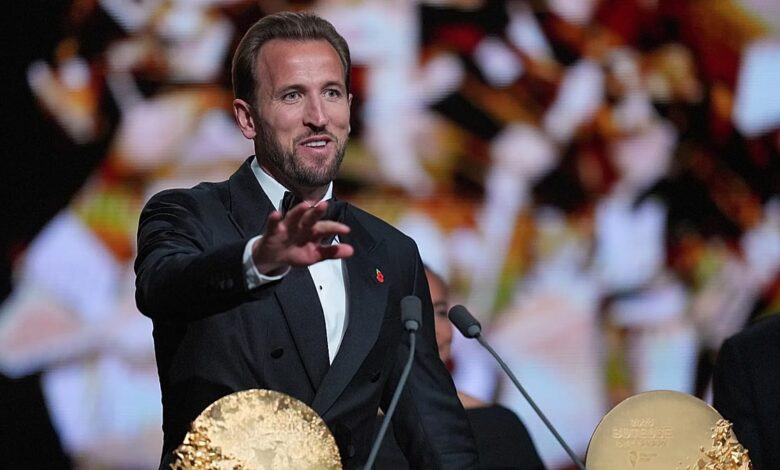
The award validates a sensational 2025/26 campaign in which Kane shattered scoring records on multiple fronts. He amassed 73 goals for club and country, a tally that established him as Europe’s top scorer. At the club level, he struck 61 goals in 51 appearances for Bayern Munich, the most ever recorded by a player in a single campaign for the Bavarians. This domestic dominance was complemented by international success, where Kane captained England to a third-place finish at the World Cup, the nation’s best placing in 60 years.
The statistical case for Kane’s victory rests on the sheer volume of his output. In the Bundesliga, his goal-scoring prowess was instrumental in leading Bayern Munich to a double, securing both the league title and the German Cup. He capped the domestic run with a hat trick against Stuttgart in the cup final, while Bayern also advanced to the Champions League semifinals. On the international stage, Kane scored six goals during the World Cup tournament. This performance allowed him to surpass Gary Lineker as England’s all-time leading World Cup scorer, placing him among the top five scorers in the tournament’s entire history.
The competitive field behind Kane was formidable, yet the gap in performance was decisive. Kylian Mbappé of Real Madrid and France finished second in the voting, while Lamine Yamal of Barcelona and Spain took third. Yamal was also voted the best young talent for the third consecutive year. Rodri, the 2024 winner, and Lionel Messi, the record eight-time recipient, also featured in the top rankings. For Kane, the victory signifies a return to the pinnacle of individual recognition for English players, a title that had eluded the nation since Michael Owen’s triumph in 2001.
Owen’s 2001 win occurred at the age of 22, a year defined by his electric pace and clinical finishing as he helped Liverpool secure a domestic treble. Since then, the award has evolved from a European-only prize to a global competition open to all players since 2007. Previous English winners include Kevin Keegan, who won the award in 1978 and 1979, and Bobby Charlton in 1966. Stanley Matthews claimed the inaugural prize in 1956. While players like Billy Wright, Bobby Moore, David Beckham, and Frank Lampard finished as runners-up, they never secured the gold. More recently, Lucy Bronze and Beth Mead also finished second in their respective years.
Kane’s achievement also holds specific significance for German football. He becomes the first player based in the Bundesliga to win the Ballon d’Or since Matthias Sammer in 1996. He joins a distinguished lineage of winners from the league, including Gerd Müller, who won in 1970 after scoring 38 league goals and helping West Germany finish third at the World Cup. Franz Beckenbauer won twice (1972, 1976), Allen Simonsen won in 1977, and Karl-Heinz Rummenigge won in 1980 and 1981. Keegan, who won while playing for Hamburg, remains the only Englishman to have won the award multiple times.
At the ceremony, Kane reflected on the path that led him to the stage, emphasizing resilience over innate privilege. “My journey wasn’t straightforward. I wasn’t the kid who went straight to the top. I had to experience the downs,” Kane said, addressing young players. He framed the victory as a product of hard work during periods of obscurity, stating, “Anything is possible with hard work, when no one else is watching, to go through the ups and downs, to learn through resilience, determination and self-belief.” He also paid tribute to his personal support system, thanking his wife Kate as his “best friend” and “biggest supporter,” and noting the ceremony’s location in London as a “good omen.”
The result solidifies Kane’s status as England’s modern talisman. By combining record-breaking club statistics with a historic World Cup campaign, he has not only claimed the individual accolade but also provided a tangible link between the historical legacy of English football stars and the current era. The award underscores a shift in the competitive landscape, where English dominance in individual recognition has returned after a quarter-century absence, setting a new benchmark for future campaigns.
With the Ballon d’Or secured, Kane’s attention now turns to the next phase of his career. The recognition serves as a culmination of the 2025/26 season, but it also resets the competitive narrative for the upcoming international fixtures and club challenges. The stage has been set for the next cycle of voting, where Kane will defend his status as the world’s best against a new generation of contenders.