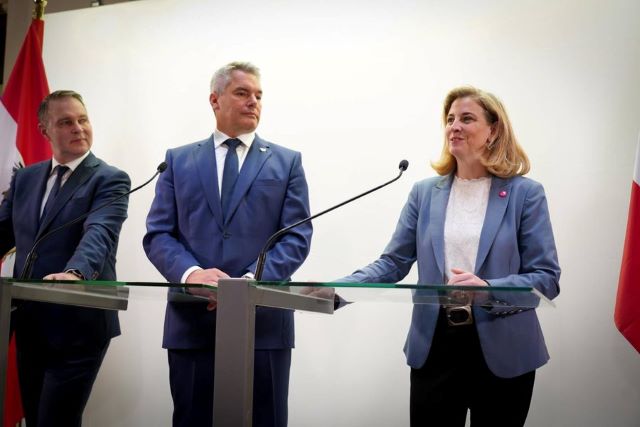
The formation of this “coalition of reason” follows the longest period of government negotiations in Austria’s recent history, punctuated by the failure of two earlier attempts to form a stable administration. The new Chancellor, Christian Stocker of the ÖVP, presented the joint programme alongside SPÖ leader Andreas Babler and Neos leader Beate Meinl-Reisinger. Stocker described the negotiations as “perhaps the most difficult in the history of our country,” but emphasized that the resulting programme represents a “breakthrough” rather than a minimal compromise.
“Our country needs change and new paths in key policy areas—a consistent migration policy, an economic policy that leads to growth and a performance-based society,” said Chancellor Karl Nehammer, who initiated the coalition talks after being charged with forming the government by President Alexander Van der Bellen.
The political maneuvering was driven by the FPÖ’s unprecedented victory in the September election, where it secured 29% of the vote, its best-ever performance. However, the FPÖ’s 183-seat National Council share fell short of the 92 seats required for a majority. With other parties ruling out cooperation with the Eurosceptic and Russia-sympathetic FPÖ, President Van der Bellen mandated the ÖVP to form a government. The ÖVP, holding 51 seats, and the SPÖ, holding 41 seats, lacked a majority on their own, necessitating the inclusion of the liberal Neos, which won 18 seats with 9.1% of the vote.

The joint programme prioritizes economic stability and stricter migration controls. To avoid an EU procedure for running an excessive budget deficit, the coalition has outlined measures including an increased levy on banks. On migration, the parties have agreed to tougher asylum measures, including a temporary suspension of family reunification and the potential imposition of an asylum freeze if application numbers rise. A specific provision includes a headscarf ban for girls under 15, while Stocker stated that an “integration year for refugees” would begin from the day of their arrival in Austria. The programme also reaffirms the government’s commitment to a “strong and better European Union.”
Despite the announcement of a deal, the path to government is not yet fully cleared. The administration is scheduled to take office next week, contingent upon final approval by the respective party memberships. The most significant hurdle remains a vote at a Neos party meeting scheduled for Sunday, where a two-thirds majority is required to ratify the coalition agreement.
The exclusion of the FPÖ has drawn sharp criticism from the party’s leader, Herbert Kickl. He dismissed the new government as a coalition of “losers” and called for a snap election. In a social media post, Kickl expressed frustration at the timing of the programme’s release, stating, “I don’t think this has ever happened before: a so-called ‘government programme’ before a government has even been formed.”
The formation of this centrist bloc represents a strategic effort to isolate the FPÖ and restore policy continuity in areas such as economic recovery, health, and climate. While the FPÖ remains the largest single party in parliament, its inability to secure coalition partners ensures its continued opposition status. The next formal step is the Neos internal vote on Sunday, which will determine whether the new government can officially assume its duties next week.