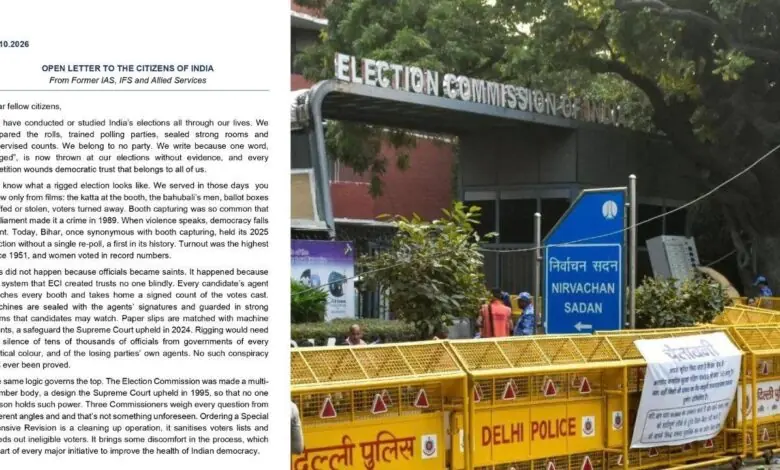
The joint statement serves as a direct defense of the institutions responsible for conducting free and fair elections in India, challenging the narrative that the process is “rigged” when specific political outcomes are unfavorable to certain parties. The former officials, who have retired from various levels of the electoral administration, emphasized the structural integrity and independence of the ECI in managing the electoral cycle.
The core of the statement addresses the recurring political discourse surrounding the credibility of voting results. By using the phrase “Rigged when you lose?” in the context of their defense, the signatories implied that accusations of fraud are often reactive and partisan in nature, emerging primarily in the aftermath of electoral defeats rather than being supported by consistent, independent evidence of systemic malpractice.
Institutional Response to Political Allegations
The intervention by these former officials is significant as it represents a unified front from within the ranks of the electoral administration itself. The Election Commission of India is the constitutional body charged with the superintendence, direction, and control of elections to Parliament and the State Legislatures, as well as the election of the President and Vice-President. Its mandate is to ensure that elections are conducted in a free and fair manner, free from coercion, intimidation, or corruption.

The State Information Technology Institute (SIR), often involved in the technical aspects of election management and the deployment of Electronic Voting Machines (EVMs), was also represented in this collective response. This inclusion underscores that the defense extends not only to the administrative and legal procedures overseen by the ECI but also to the technological infrastructure utilized in the voting process. The former officials asserted that both the administrative and technical components of the election process have withstood scrutiny and operate according to established protocols designed to prevent tampering.
Context of Electoral Integrity Debates
Allegations of “vote chori” have become a prominent feature of Indian political discourse, frequently cited by opposition parties and political leaders who do not accept election results. These claims often question the transparency of the count, the integrity of the EVMs, or the conduct of election officials. However, the legal and judicial systems in India have generally upheld the results of elections conducted under the ECI’s supervision, with challenges typically resolved through formal legal channels rather than through the acceptance of unsubstantiated claims of systemic rigging.
The Election Commission maintains that it adheres to strict guidelines and security protocols to ensure the secrecy and integrity of the vote. This includes the sealing of EVMs, the presence of observers from various political parties during the counting process, and the availability of paper trail verification mechanisms in many constituencies. The former officials’ statement reinforces the position that the existing framework is robust and that the institution remains neutral in its operations, irrespective of the political party that emerges victorious in any given election.

This joint statement does not constitute a new policy directive or a change in electoral procedure. Rather, it is a declarative document aimed at countering public misinformation and reaffirming the professional consensus among those who have served in the electoral administration. It highlights a distinction between political dissatisfaction with results and established facts regarding the conduct of the election.
No immediate legal proceedings or institutional changes have been announced as a result of this statement. The Election Commission continues its routine functions, including the scheduling and management of future elections. The statement is expected to be cited in ongoing debates regarding electoral reform and the role of the judiciary in adjudicating election disputes. The next major electoral events will proceed according to the existing constitutional and legal framework, with the ECI retaining its primary authority over their conduct.