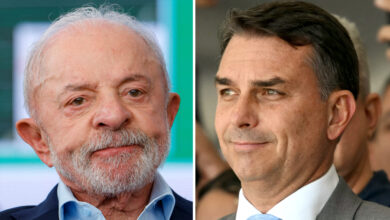

The subdued nature of the speech signaled a change in strategy. Bolsonaro, who was sentenced to 27 years in prison last year for attempting to overturn the 2022 election defeat and barred from holding public office for eight years, appears to recognize that his own political career is largely finished. However, his personal popularity has remained steady in the low 40s percent range over the past year. His influence has not dissipated; instead, it has transferred to his family. For the third consecutive election, a member of the Bolsonaro family is the leading right-wing contender for the presidency, this time in the form of his eldest son, 45-year-old Senator Flávio Bolsonaro.
The upcoming presidential election has reached a critical juncture, with Flávio Bolsonaro and incumbent President Luiz Inácio Lula da Silva locked in a statistical tie. A poll released on September 24 by the public opinion firm Datafolha showed Lula with a slim lead in a simulated runoff, earning 47 percent support to Flávio’s 45 percent, a margin well within the error range. Other pollsters predict an even narrower gap. This outcome was a surprise to many observers. While a runoff was expected due to a fragmented right-wing field, positive economic indicators under Lula’s administration had led analysts to predict a stronger position for the incumbent. The consensus has since shifted to view the second round, scheduled for October 24, as essentially a toss-up, with Flávio Bolsonaro now considered a probable, though not certain, winner.
The political significance of this race extends beyond the candidates. It represents the endurance of “Bolsonarismo”—a conservative movement fueled by a growing evangelical demographic, which accounted for about a third of Brazil’s population in the 2022 census and may outnumber Catholics by 2033. The movement’s trajectory is now a point of contention. While Bolsonaro remains the spiritual leader, his legal constraints have opened the door for potential successors. São Paulo state Governor Tarcisio de Freitas, a career technocrat who previously worked in Workers’ Party governments, has emerged as a figure who might represent conservative politics without the anti-democratic tumult associated with Bolsonaro. A survey of attendees at Bolsonaro’s recent rally found that 61 percent preferred Freitas to succeed the former president, compared to 19 percent who named former First Lady Michelle Bolsonaro.
However, the prospect of a Bolsonarista victory carries significant institutional risks. If Flávio Bolsonaro wins outright, the immediate threat of a constitutional crisis may be mitigated. But if Lula were to win the second round, observers warn that Bolsonaristas are likely to refuse to recognize the result, potentially creating a constitutional crisis. This mirrors the trajectory of the 2022/2023 period, where the former president actively planned an insurrection that was poorly executed, with Congress not in session and the president out of town. The warnings issued by the United States administration and foreign senators for the Brazilian military to respect the democratic process were crucial in preventing further destabilization at that time.
Currently, Bolsonaro remains in a state of indefinite legal limbo. Police confiscated his passport earlier this month, fueling speculation about an imminent arrest, though sources in Brasília suggest this is not immediate. As long as the former president refrains from direct attacks on the Supreme Court, he maintains considerable political capital. The coming weeks will determine whether the Brazilian electorate chooses to continue with the incumbent’s economic stewardship or embrace a new phase of the conservative movement, led by a dynasty that has proven its ability to adapt to legal and political setbacks.