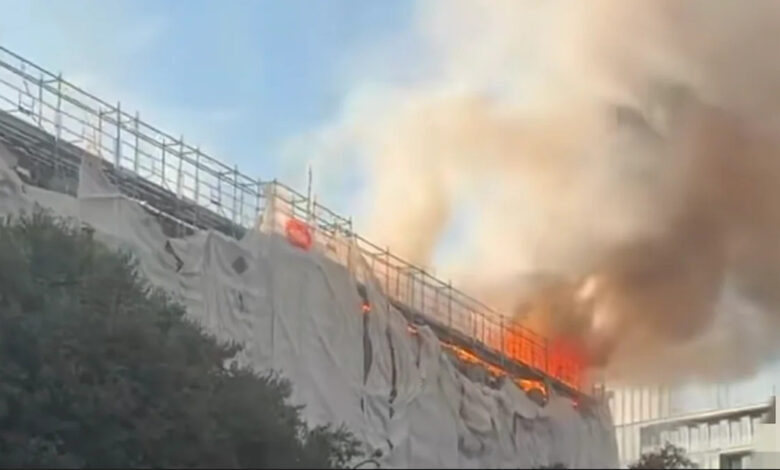
The fire is now under control, with officials confirming that there were no injuries among the public or emergency personnel. Approximately 1,000 square meters of the roof were destroyed in the incident, and the flames also spread to portions of the building’s fourth and top floors. The cause of the fire remains unknown at this stage, and investigations are ongoing to determine how the blaze started.
The scale of the emergency response was substantial, with about 100 firefighters and roughly 30 vehicles deployed to the scene. Visual footage from the area showed firefighters operating from aerial platforms to tackle the flames engulfing the roof, working from height to contain the inferno. The dense smoke visible from several columns rising above the station marked the intensity of the blaze, which broke out in the morning hours before being brought under control.
The incident occurred in an area that has been undergoing significant modernization since 2023. The redevelopment programme, which is scheduled to continue until 2028, has transformed the landscape around the station. Despite the proximity of the fire to the railway infrastructure, the station itself was not impacted, and passenger areas were not evacuated. SNCF, the French national railway company, confirmed that train traffic was unaffected by the emergency. However, as a precautionary measure, the entrance to the station on the Boulevard de l’Hôpital side was closed, and passengers were directed to use other available entry points under the guidance of police officers.
While the passenger terminal remained open, administrative offices in the vicinity were evacuated due to potential power supply issues. Railway security indicated that Enedis, the French distribution network operator, planned to cut the power supply to the site to prevent further electrical hazards. This precautionary step highlighted the interconnected risks between construction sites and critical urban infrastructure, even when the immediate threat to life is contained.
A security perimeter was established around the affected area, and access to Boulevard de l’Hôpital was blocked to ensure the safety of the public and to allow emergency services to operate effectively. Residents and commuters in the immediate vicinity were advised to keep lanes clear for emergency vehicles, stay away from the smoke, and comply with instructions from police and firefighters. The closure of the street and the station entrance on that side underscored the logistical impact of the fire on local traffic, even though the broader network continued to function normally.
The incident serves as a reminder of the challenges associated with large-scale urban redevelopment projects in dense metropolitan areas. The combination of active construction, high-value future infrastructure, and proximity to a major transport hub requires coordinated safety measures. While the fire did not disrupt the flow of passenger travel, the evacuation of administrative staff and the temporary closure of key access points illustrate the potential for localized disruption during such emergencies.
As the fire crews worked to extinguish the remaining hotspots, the focus shifted to assessing the full extent of the damage to the building. The destruction of the roof and parts of the upper floors may impact the timeline of the renovation project, though specific details regarding the structural integrity and financial cost of the damage have not yet been released. The cause of the fire is still under investigation, with authorities examining the site to identify any electrical faults or other factors that may have contributed to the outbreak.
The episode highlights the resilience of urban emergency services in managing crises near critical infrastructure. The swift deployment of resources and the clear communication regarding passenger safety helped maintain order in a busy part of the capital. As the smoke cleared and the immediate danger passed, the area began to return to normal, with police managing the flow of traffic and ensuring that the security perimeter remained intact until further assessments were completed.
The future of the building at 3, Boulevard de l’Hôpital, and its role as the headquarters for EssilorLuxottica, may now face delays or additional scrutiny regarding construction safety protocols. The incident, while contained without loss of life, adds another chapter to the ongoing modernization of the Gare d’Austerlitz district, a project that continues to shape the urban landscape of Paris through 2028.