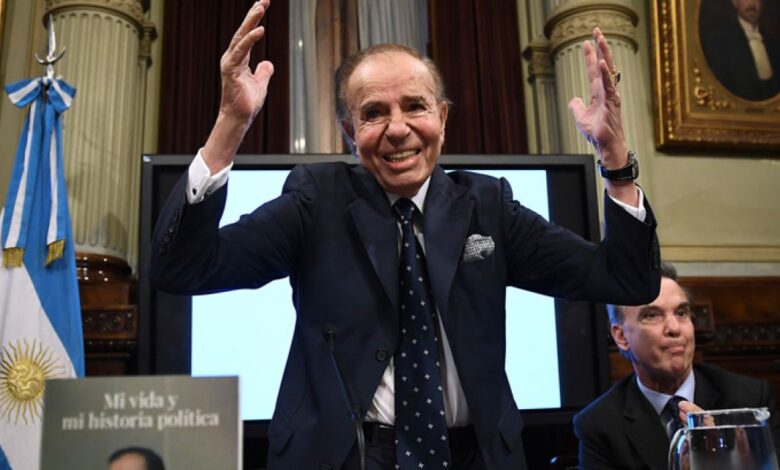
The court annulled the judgment on the grounds that the “reasonable time” principle for finalizing a criminal sentence had not been met. A source inside the court told the AFP news agency that the decision was not a strict declaration of innocence, as the judges did not rule on the merits of the case but rather on the excessive duration of the proceedings.
Menem, 88, was originally charged as the co-author of shipments exceeding 6,000 tons of military weapons, including mortars, land mines, grenades, and missiles, between 1991 and 1995. Prosecutors alleged that arms authorized for Venezuela and Panama were instead diverted to Ecuador and Croatia. At the time, Argentina was barred from supplying weapons to Ecuador due to its peacekeeping role following the 1995 conflict with Peru, while Croatia was under a United Nations arms embargo during the Yugoslav wars. Menem has consistently denied the charges, stating he believed the arms were destined for Panama and Venezuela. As a senator for La Rioja province, he holds immunity from arrest and did not serve his previous prison terms.
In a separate but related development, a three-judge panel in Buenos Aires concluded a four-year trial concerning the cover-up of the 1994 bombing of the Argentine Israelite Mutual Association (AMIA) center. The attack, which killed 85 people and injured hundreds, remains Argentina’s deadliest terrorist incident. In this case, Menem was acquitted of charges that he attempted to interfere with the investigation. A dozen other co-defendants were also acquitted of the specific charge of interference.
However, the court found former federal judge Juan José Galeano, who led the initial AMIA probe, guilty of concealment and violation of evidence. Galeano was sentenced to six years in prison. The court determined that Galeano had paid Carlos Telleldín, a used car dealer, US$400,000 to implicate a group of police officers in a supposed “local connection” to the bombing. Telleldín was sentenced to three-and-a-half years in jail. Former intelligence chief Hugo Anzorreguy, whose agency provided the funds, was sentenced to four-and-a-half years for embezzlement and concealment. Former prosecutors Eamon Mullen and José Barbaccia each received two-year sentences for failing to fulfill their duties as public officials.
Menem’s lawyer, Omar Daer, stated that the former president felt “relieved” by the acquittals, noting that no evidence justified an illicit act on Menem’s part regarding the AMIA case. Critics, however, reacted sharply. Graciela Ocaña, a lawmaker for the Cambiemos party, argued that the arms smuggling ruling granted “impunity” after 22 years of judicial processing. The victim support group Memoria Activa condemned the AMIA verdicts, asserting that the Menem government had knowledge of the impending attack and failed to prevent or properly investigate it. No one has yet been convicted of the actual 1994 AMIA bombing itself.
The arms smuggling case had originated in 1995 while Menem was still in power. He appealed the 2013 lower-court conviction to the Supreme Court, which referred the matter to the Federal Chamber of Criminal Cassation. The AMIA cover-up trial was ordered in August 2015 following a 2004 court ruling that identified irregularities in the original investigation. Galeano denied acting on Menem’s orders, a claim prosecutors had contested during the trial.
With the cassation court’s decision, the arms smuggling case against Menem is closed unless a further constitutional appeal is filed, though the provided sources do not specify a deadline for such an appeal. Galeano and other convicted officials are subject to immediate enforcement of their prison sentences, although the sources do not detail the exact date of their incarceration.