
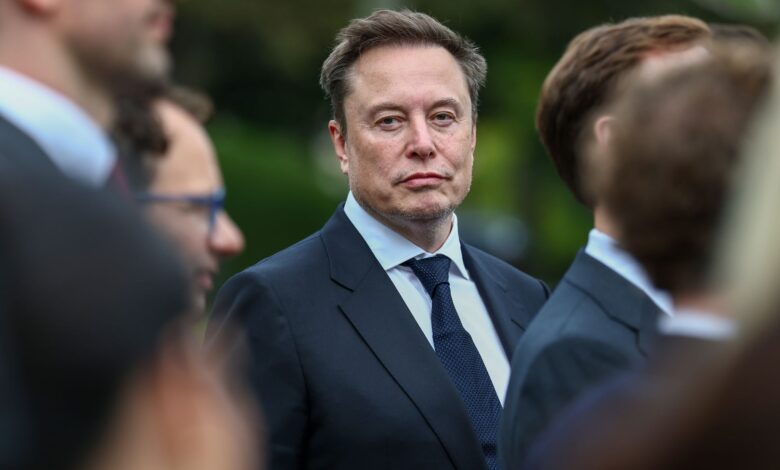
The conflict centers on Musk’s allegation that Ukraine’s military violated Starlink’s terms of service by using commercial terminals for “offensive drone strikes to kill people.” Musk claimed that this “loophole” has now been closed. In response, Zelensky clarified that Ukraine uses both commercial Starlink terminals and their militarized variant, Starshield, strictly to defend against Russian forces on Ukrainian soil. “But the point is that we use it against Russian troops on our territory, not on Russian territory. They came here to kill,” Zelensky added, emphasizing the defensive nature of the engagements.
The diplomatic friction is compounded by the practical consequences of the restrictions imposed earlier this month. Starshield was temporarily speed-restricted to 160 kilometers per hour in Ukraine, a measure that directly impacted the performance of Ukrainian drone interceptors. Zelensky revealed that Ukraine was in the process of successfully testing its jet-powered Bars drone interceptors—2,000 units of which were funded by a European country—when the restrictions took effect. The speed limit disrupted these operations and other military efforts, leading to a measurable decline in air defense efficiency.
“Of course, civilians died while Starlink/Starshield were switched off,” Zelensky said, citing the human cost of the disruption. He noted that while the restrictions were in place, Ukraine’s interception rate for Shahed-type drones dropped to between 50% and 78%. Under normal conditions, the figure is approximately 90%. The president indicated that during the period of restriction, Ukrainian forces acted “a little more cautiously,” though they were not ordered to refrain from responding to Russian strikes entirely.
Responsibility for the throttling of the systems remains officially unassigned, adding a layer of ambiguity to the geopolitical tension. While Trump administration officials have pointed fingers at Musk, the former prosecutor general’s silence and the broader context of U.S.-Ukraine relations complicate the narrative. The Wall Street Journal reported on October 23 that President Donald Trump had ordered the SpaceX CEO to lift the restrictions. However, Trump publicly claimed he had not spoken to Musk about the issue, suggesting he might intervene if the problems persisted. Zelensky himself expressed uncertainty about the source of the order. “So I really don’t know who told SpaceX to do that,” he said, suggesting it could be either a personal decision by Musk or an instruction from a U.S. official, while noting that technically, SpaceX controls the activation and deactivation of these systems.
Ukrainian officials have consistently rejected the premise that Kyiv is violating service terms. Presidential adviser Serhii “Flash” Beskrestnov highlighted that commercial Starlink has a standard speed restriction of 70 to 90 kilometers per hour and does not function on Russian territory, undermining the claim that the infrastructure was being used for cross-border attacks. By October 24, Zelensky confirmed that both Starlink and Starshield were operating at full speed again, restoring Ukraine’s capacity to defend its energy grid and civilian population.
This technical dispute unfolds against a backdrop of deteriorating relations between Washington and Kyiv. The restrictions occurred as the Trump administration eased sanctions pressure on Moscow and accused Zelensky of lacking interest in peace, despite Kyiv repeatedly supporting U.S.-backed ceasefire proposals that Russia subsequently rejected. The strategic stakes are high; Zelensky has noted that Ukraine needs to intercept around 150 Russian ballistic missiles per month but receives only about 150 Patriot missiles from the U.S. annually. This deficit underscores the reliance on electronic warfare and drone interception capabilities, making the availability of Starlink and Starshield vital to national survival.
Public sentiment in Ukraine remains firm on the necessity of continued defense. A survey indicated that 80% of respondents support continued strikes, even if Washington restricts intelligence sharing or Starlink operations, with only 11% suggesting Ukraine should pause attacks. The government is also navigating severe economic pressures, with security and defense allocations accounting for roughly two-thirds of planned expenditure and a projected deficit of nearly 1.7 trillion hryvnia ($37 billion). Dutch Foreign Trade Minister Sjoerd Sjoerdsma, visiting Kyiv, emphasized that support for recovery cannot wait for a ceasefire, highlighting the need for immediate military and economic assistance.
As the immediate technical restrictions are lifted, the underlying diplomatic tensions persist. Zelensky’s rebuttal serves not only to correct the record on the use of Starshield but to assert Ukraine’s sovereign right to self-defense. The incident highlights the growing complexity of modern warfare, where commercial satellite infrastructure plays a decisive role in the outcome of conventional military engagements, and where the boundaries between corporate policy, national security, and diplomatic leverage are increasingly blurred.