
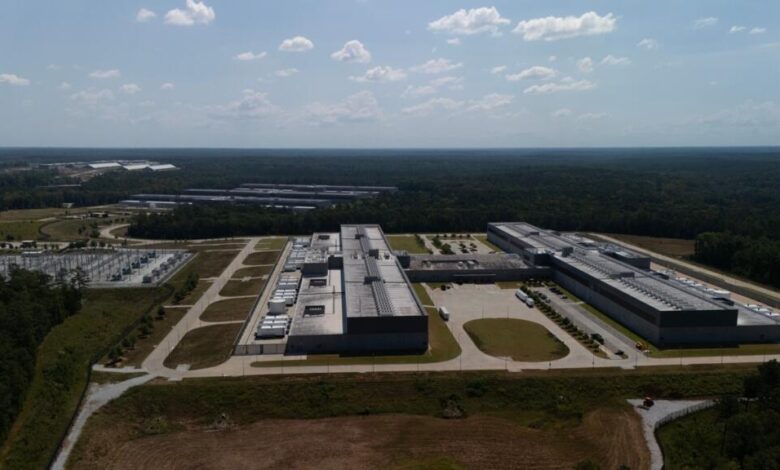
At the heart of this tension is the economic engine driving the AI revolution: capital expenditure on physical infrastructure. The narrative of AI as a software-only revolution has given way to a reality of massive, energy-intensive hardware deployment. However, the financial architecture supporting this build-out is under strain. The price of money, specifically higher interest rates, acts as the pin that deflates market bubbles. For a sector heavily reliant on debt financing to secure land, power, and servers, the cost of capital is not merely a line item; it is a structural constraint that threatens to alter the pace and scale of deployment.
The technological significance of this shift lies in the coupling of AI model development with physical economics. While large language models and generative AI systems require vast computational resources, the ability to deploy these resources is increasingly dictated by financial viability and regulatory permission. The “AI mania” that has characterized the past few years is being tested by the harder realities of monetary policy. When interest rates remain elevated, the return on investment for speculative data centre projects diminishes, forcing a more disciplined approach to expansion. This financial pressure intersects with the political resistance seen in states like Georgia, where the environmental and social costs of data centres have become a tangible voting issue.
The implications for debt holders in the data centre construction sector are profound. Delays in construction, driven by political opposition or regulatory hurdles, extend the period during which debt must be serviced without generating revenue. As the FT notes, these delays create significant risks for those holding the associated debt. The boom in AI infrastructure was predicated on rapid deployment; however, the friction from local communities and the drag from high borrowing costs are slowing this process. This creates a divergence between the optimistic projections of AI capability and the slower, more contested reality of infrastructure rollout.
For users and businesses, this means the availability of certain AI services may become more stratified or expensive in the short term. The “free” or subsidized tiers of AI services, often underwritten by venture capital and speculative debt, may become less sustainable if the underlying infrastructure cannot be built quickly or cheaply. The focus shifts from pure model performance to the efficiency of the infrastructure that runs it. Developers and enterprises must now consider not only the algorithmic efficiency of their AI models but also the geographical and financial viability of the data centres that host them.
Privacy, security, and competition questions are also being reshaped by this political and economic friction. As data centres face greater scrutiny from local communities, there is increased pressure for transparency regarding energy usage, water consumption, and local economic impact. This scrutiny could lead to more diverse regulatory frameworks across different US states, complicating the deployment of national or global AI services. Competition among AI providers may no longer be solely determined by the sophistication of their models but by their ability to navigate local political landscapes and secure stable, low-cost power supplies.
The evidence supporting the current AI boom is robust in terms of technological capability, but the evidence for its sustainable, rapid expansion is becoming more mixed. While companies continue to announce massive capital expenditure budgets, the on-the-ground reality in places like Georgia suggests that these plans face significant hurdles. The distinction between announced projects and completed, operational data centres is widening. Delays in construction not only affect the timing of capacity additions but also signal a broader recalibration of expectations for the AI sector.
This recalibration affects institutions and investors who have bet on the unlimited scalability of AI infrastructure. The assumption that compute demand would outstrip supply indefinitely, justifying aggressive debt financing, is being challenged by the “pin” of high interest rates and the “wall” of political opposition. The result is a sector that must prove its value not just through technical benchmarks but through its ability to coexist with local communities and withstand financial cycles.
As the 2026 midterm elections approach, the outcome of this struggle in states like Georgia will be closely watched. If opposition to data centres continues to unite voters across party lines, it could lead to stricter regulations on new construction, further slowing the expansion of AI infrastructure. Conversely, if the financial pressures from high interest rates force a consolidation of the market, we may see a more sustainable, albeit slower, growth pattern for AI compute capacity.
Returning to the front line in Georgia, the conflict between the promise of AI and the reality of its infrastructure is no longer abstract. It is a concrete struggle over land, power, and political will. The next confirmed development in this narrative will likely be the outcome of local regulatory decisions and the financial health of data centre developers as they navigate a high-interest-rate environment. The AI mania may not disappear, but it is being deflated by the hard constraints of finance and democracy, forcing the industry to mature from a phase of speculative rapid growth to one of disciplined, sustainable expansion.