
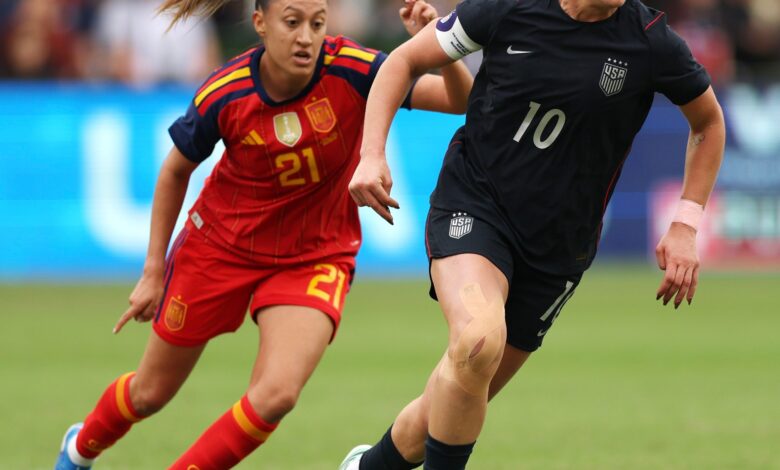
The narrative of the match was established within the first 15 minutes, a period that defined the competitive significance of the encounter. Spain, the top-ranked team in the world, took an early lead that proved insurmountable. Just three minutes into the contest, captain Laia Codina won possession near midfield, initiating a sequence that saw midfielder Patricia Guijarro whip a shot from outside the box through traffic into the left side netting. This goal set the tone for a physical battle, characterized by numerous hard fouls, but it was Spain’s tactical discipline that ultimately prevailed. The United States, despite being the reigning Olympic champions, struggled to convert their dominance into goals, a pattern that would haunt them for the remainder of the 90 minutes.
Spain’s second goal, arriving in the 14th minute, further solidified their advantage and exposed the defensive vulnerabilities of the U.S. backline. Isolated on the left flank against defender Tierna Davidson, winger Salma Paralluelo cut toward the endline and lofted a cross toward the far post. Forward Eva Navarro made a run inside the box and connected with the service first-time, striking the ball past the outstretched gloves of goalkeeper Claudia Dickey and into the roof of the net. This strike was documented as a “world class” effort, highlighting the technical disparity between the two sides in critical moments. With the score at 2-0, Spain shifted focus to preserving their lead, holding off an onslaught of shots from the U.S. to secure their second-ever victory against the United States.

Statistical analysis of the match reveals a stark divergence between volume and outcome. After the first 15 minutes, the U.S. dominated the attacking end, recording 13 shots, 10 of which were on target. In contrast, Spain recorded only three shots on goal, all of which were taken in the first half, and two resulted in goals. This efficiency gap was the primary factor in the outcome. The U.S. lack of efficiency in the final third, paired with Spain’s ability to capitalize on limited opportunities, proved to be the Americans’ undoing. The physical nature of the match was underscored by one red card issued to Spain, a moment that did not alter the fundamental dynamic of the contest but added to the intensity of the proceedings.
The performance of individual U.S. players highlighted the team’s frustration. Alyssa Thompson was a primary threat on the right wing, engaging in a give-and-go with midfielder Rose Lavelle. Thompson’s cross was initially cleared by Spain, but Lavelle won the ball back and laid it off to captain Lindsey Heaps, whose low shot was saved by goalkeeper Adriana Nanclares. Moments later, Thompson made another long run down the right flank, sending a cross into the box that resulted in forward Trinity Rodman’s first touch popping up high for Nanclares to collect. These moments illustrated the U.S. ability to create chances, but the inability to finish them off was a recurring theme. The Americans were inches away from cutting the deficit in half a few moments later, when midfielder Lily Yohannes volleyed a shot from the center of the penalty area that rolled just wide after a scramble in the box off a failed clearance from Spain.
The result has significant implications for the broader competitive landscape. Spain’s victory extends their all-time unbeaten record, a statistical milestone that underscores their dominance in international women’s soccer. The match also serves as a reminder of the high stakes involved in encounters between the top-ranked teams. For the U.S., the loss marks a setback in their pursuit of maintaining their status as a perennial powerhouse. The physical nature of the match, with its hard fouls and red card, suggests a rivalry that is as intense off the ball as it is on it.
While the focus remains on the sporting contest, the wider footballing community is also grappling with tragedy. In a separate but somber development, Spain’s football community has united in grief following the death of Tenerife player Jesus de Miguel. De Miguel, 30, suffered cardiac arrest after colliding with Andorra goalkeeper Jesus Owono while challenging for a high ball during a second-division match earlier this week. He died in hospital the following day. The funeral was held in Navahermosa, a town of about 3,000 people in central Spain, where De Miguel’s parents were reportedly born. Spain coach Luis de la Fuente and Real Madrid President Florentino Perez attended the service, with De la Fuente stating that the game’s community “stands united” in grief. Police have opened a routine investigation into possible involuntary manslaughter to assess whether the challenge went beyond normal play. This tragedy adds a layer of gravity to the Spanish football landscape, contrasting sharply with the competitive triumph in Washington, D.C.
As the teams prepare for their next fixtures, the unresolved questions remain. Can the U.S. adjust their attacking efficiency to overcome Spain’s defensive structure? Will Spain’s unbeaten run continue against future opponents? The match at Audi Field provided answers to some questions, but it also raised new ones about the trajectory of the global women’s soccer landscape. The decisive moment, the 14th-minute strike by Eva Navarro, remains the defining image of the encounter, a testament to Spain’s ability to deliver when it matters most.