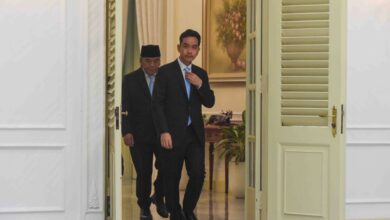
The resignation follows a period of intense scrutiny triggered by rulings from the Constitutional Court and Supreme Court last month, which determined that Gibran’s education documents did not meet statutory election requirements. These legal determinations set the stage for a broader political crisis, with over 100 lawmakers—specifically cited as 120 in parliamentary records—signing a petition seeking his impeachment. The move signals not only a challenge to individual eligibility but a rupture in the political compact that secured Prabowo’s victory in 2024.
Gibran stated his intention to resign during a meeting with Prabowo on Tuesday. The procedural next steps are now in motion: the parliamentary upper house, which oversees the approval of resignations and the selection of replacements, is expected to receive the formal letter on Thursday morning. Two sources in the upper house confirmed that the body will need to convene a session to declare the vacancy and subsequently write to the president requesting two nominees for the position.
The political significance of this resignation extends far beyond the vice-presidency. It crystallizes a widening rift between Prabowo, a powerful former general, and Joko Widodo, widely known as Jokowi, a highly popular leader who twice defeated Prabowo for the presidency before throwing his support to him after facing term limits. Gibran’s candidacy was instrumental in helping Prabowo win the 2024 election by a huge margin, but that alliance is now under severe strain.
Tensions escalated sharply last week when Prabowo dismissed his chief of staff, a figure widely seen as a loyalist to Jokowi, after the official was arrested on accusations of bugging the president and other high-ranking figures. This personnel purge, occurring just days before the vice president’s resignation, suggests that the conflict has moved from procedural disputes to fundamental questions of loyalty and control within the administration.
The institutional process now unfolding highlights the checks and balances at play in Indonesia’s governance structure. While the president initiates the replacement process by submitting two nominees, the parliamentary upper house holds the power to approve the resignation and ultimately select the successor. This procedural hurdle means the crisis is not resolved by the act of resignation alone; it requires legislative consensus, potentially forcing further negotiations among the coalition parties.
The development arrives at a precarious moment for Indonesia’s economy. Analysts note that an open split between the two dominant political figures could spark further instability for an administration already hit by scandals regarding signature programs, such as its free school meals policy. There are also growing doubts about the government’s handling of the economy. Investor sentiment has weakened towards Indonesia this year amid heightened scrutiny of fiscal plans and broader policy directions. Additionally, lingering risks of a downgrade for the Indonesian stock market by global index provider MSCI add a layer of financial precariousness to the political turmoil.
Prior to the resignation, the political atmosphere was charged with anticipation. When parliament reconvened on Tuesday following a one-month recess, House Speaker Puan Maharani indicated that many opinions on Gibran’s eligibility had been received. Lawmakers were weighing the possibility of a probe into whether his incomplete education documents disqualified him as vice president. The fact that the impeachment petition gathered 120 signatures indicates that a significant bloc of legislators was prepared to act against him, suggesting that the resignation may have been a response to an impending, and likely successful, formal removal process.
Gibran’s office did not immediately respond to requests for comment on the specific terms of his departure or his future political intentions. The lack of immediate clarity from his camp adds to the uncertainty surrounding the transition. However, the core political reality is clear: the partnership between the Prabowo and Jokowi camps, which defined the recent electoral landscape, is fracturing.
The immediate consequence is a vacancy in the second-highest office of the state, leaving the president to govern without a vice president for an unspecified period. The selection of a replacement will be a critical test of the remaining coalition’s cohesion. If the split between Prabowo and Widodo’s camp becomes official, it risks destabilizing the administration’s ability to manage both domestic policy and economic expectations.
As the upper house prepares to receive the resignation letter, the focus shifts to who will fill the void. The president must now nominate two candidates, a process that will likely be scrutinized intensely by the very lawmakers who sought the vice president’s removal. The resolution of this crisis will determine whether Indonesia’s political center can hold or if the country faces a prolonged period of institutional friction.
The resignation of Gibran Rakabuming Raka is not merely a personnel change; it is a declaration of the end of a political era defined by the Jokowi-Prabowo alliance. With the next nomination process set to begin, the political stakes are high, and the path to stability remains uncertain.