A Distinct Doctrine
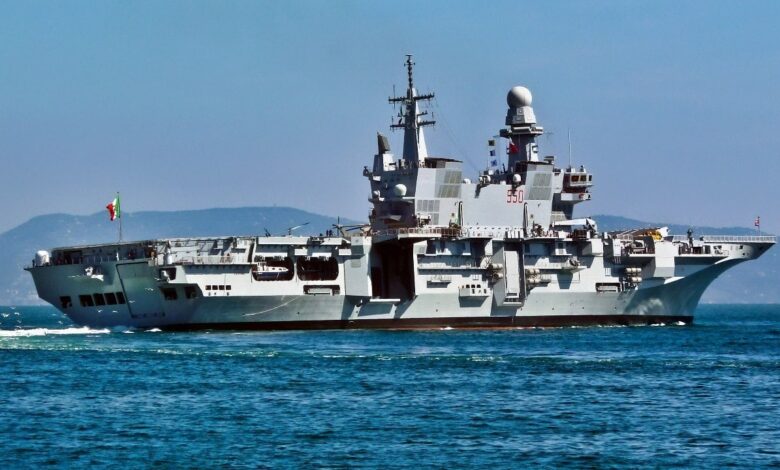
Conceived in the late 1990s and early 2000s, the *Cavour* was designed for operations in Italy’s “near abroad”—the Mediterranean, the Balkans, and parts of the Middle East—rather than global power projection. It functions as a light aircraft carrier for short takeoff/vertical landing (STOVL) aircraft and helicopters, an amphibious assault ship capable of embarking marines and vehicles, and a command center for allied operations. A key differentiator is its robust medical facility, reflecting its dual role in disaster response and peacekeeping. This design mirrors Italy’s strategic reality: it lacks the need for global reach but has a mandatory obligation to contribute to EU and NATO missions in the region.
Integration of Unmanned Systems
The most recent significant development involves the integration of Turkish Bayraktar TB3 naval drones onto the *Cavour*. This move makes Italy the first European power to deploy Turkish naval drones on a carrier deck. The collaboration was formalized through a cooperation agreement between Turkey’s Baykar and Italy’s Leonardo.
Vice Admiral Giuseppe Berutti Bergotto, Chief of the Italian Navy, explained to Parliament that the TB3 can launch one-way attack drones that “become a munition and strike the target.” This capability extends the *Cavour’s* operational reach without consuming the flight hours of its manned F-35B Joint Strike Fighters. The installation of these systems represents a tactical upgrade that enhances the ship’s versatility, allowing it to conduct strike missions with a lower operational cost and risk to pilots, while maintaining a persistent presence in contested waters.
Operational Context and NATO Posture
The *Cavour* regularly participates in high-profile NATO deterrence operations. In March 2023, it joined the U.S. Navy’s *USS George H.W. Bush* Carrier Strike Group and Spain’s *ESPS Juan Carlos I* for Neptune Strike 2023-1. This exercise involved 31 ships, 135 aircraft, and approximately 8,386 personnel from 21 NATO countries. U.S. Navy Vice Admiral Thomas Ishee, commander of Naval Striking and Support Forces NATO, stated that the exercises were designed to show that “NATO’s capability and will is not” uncertain, despite the volatile security environment.
Earlier, in November 2022, the *Cavour* participated in an unprecedented five-carrier exercise alongside the *USS Gerald R. Ford*, *Charles de Gaulle*, and *HMS Queen Elizabeth*. These frequent multi-national drills underscore the *Cavour’s* role as a linchpin of interoperability in the Mediterranean. The region is increasingly viewed as a flashpoint; Italy’s Chief of Defense noted in May that the Mediterranean “remains as dangerous today as it always has been.”
Strategic Imperatives
Italy’s focus on the Mediterranean is driven by several converging factors. Approximately 40% of global maritime trade transits the region, which is also crisscrossed by vital undersea communication cables. Furthermore, as Europe seeks to reduce dependency on Russian energy, imports of oil and gas from North Africa and the Middle East are expected to rise, increasing the volume of commercial traffic that requires protection.
Security threats in the region are multifaceted, ranging from non-state actors in the Middle East and North Africa to Russia’s increased naval presence, supported by its base in Tartus, Syria. Italy’s fifth-largest standing military in NATO, with 161,550 troops, is tasked with protecting this southern flank, which Rome defines as stretching from the Persian Gulf to the Gulf of Guinea.
The *Trieste* and Future Capabilities
To complement the *Cavour*, Italy is preparing to commission the *ITS Trieste*, the largest warship it has built since World War II. Displacing over 30,000 tons and measuring 803 feet in length, the *Trieste* is designed as an amphibious assault ship with a ski-jump ramp and a deck coated to withstand jet exhaust. It will carry approximately 600 troops and is expected to be commissioned in the near future.
The introduction of the *Trieste* and the drone integration on the *Cavour* indicate a broader trend in Italian defense strategy: a shift toward expeditionary flexibility and enhanced strike capabilities. By combining manned F-35Bs with long-endurance unmanned systems, Italy is creating a layered defense architecture capable of addressing both high-end state threats and low-intensity crises across its strategic region of interest.
As the *Trieste* moves toward induction and the *Cavour* refines its unmanned warfare capabilities, the Italian Navy is positioning itself not just as a regional partner, but as a critical node in NATO’s southern defense network.