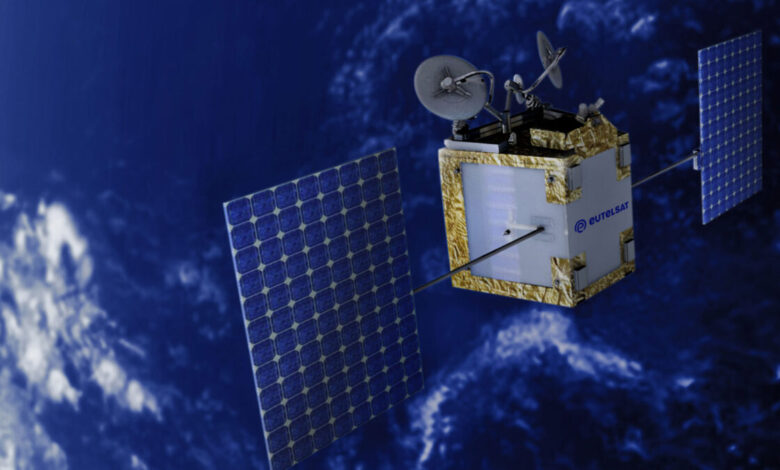
Under the agreement, Eutelsat will provide access to its OneWeb low Earth orbit (LEO) satellite network, along with portable terminals for field deployment. The contract also includes technical support and alternative positioning, navigation, and timing (PNT) services, which are critical for maintaining operations when conventional satellite navigation is unavailable or contested. Eutelsat did not specify the number of terminals to be supplied, the specific military units that will utilize the service, or the underlying technology for the alternative navigation capability.
“Today’s military operations demand communications capabilities that are agile, resilient, and available anywhere in the world,” said Ian Canning, President and CEO of Eutelsat Network Solutions. This award follows a June 2026 selection where the Space Force’s Commercial Satellite Communications Office (CSCO) identified OneWeb Technologies as a recipient of a Warrior Plans contract. The company was selected without a new competition due to its control over the OneWeb constellation and its ability to provide the required services. The Space Force has also selected SpaceX for a separate Warrior Plans contract covering Starshield, the military-focused version of its Starlink service. However, Starshield has faced scrutiny over speed restrictions affecting Ukrainian drone operations, with President Volodymyr Zelenskyy reporting in November 2026 that such restrictions had returned, limiting connectivity at speeds above 161 kilometers per hour.
OneWeb operates a significantly smaller constellation than its US competitor. As of May 2026, OneWeb has approximately 650 satellites in orbit, compared with more than 10,000 for SpaceX. To maintain and expand its network, Eutelsat has placed several orders with Airbus Defence and Space. On January 12, 2026, Airbus secured an order for 340 additional OneWeb satellites, bringing the total ordered since December 2024 to 440. These satellites are intended to gradually replace the existing fleet and support the development of Eutelsat’s LEO communications services.

While the US integrates commercial LEO assets, internal challenges persist within the Space Force’s broader satellite architecture. Sources indicate that key Space Force satellites currently cannot communicate directly with one another, a limitation likely requiring a $1 billion solution. To translate between the SpaceX-built Service Data Network (SDN) Backbone and other Pentagon communications and missile tracking satellites, the Space Force is considering 12 or 13 “Space Exchange Point” (SEP) satellites. These SEP spacecraft would allow any external government system with a compatible optical terminal to connect to the SDN Backbone.
The concept of a “translator” satellite is not new; the Space Development Agency (SDA) was exploring the idea as early as 2022 to facilitate data flow from commercial satellites into the Transport Layer. However, questions remain regarding implementation difficulty. A former Space Force official noted that while hardware challenges are straightforward, necessary networking translation adds complexity. Furthermore, the SEP satellites as currently designed are not compatible with SDA’s Tracking Layer satellites or the Transport Layer, which is being transferred to the Space Systems Command (SSC) for further development. The Transport Layer is specifically focused on connecting to legacy military platforms, such as fighter jets.
Schedule uncertainties compound these technical challenges. SDA now projects the launch of its first operational Tracking Layer satellites, Tranche 1, for next spring, representing a two-year delay. Subsequent tranches, Tranche 2 and 3, were previously projected for December and 2029 respectively, but their schedules are now unclear due to the Tranche 1 delay. The shift of the Transport Layer program to SSC has further obscured its scope, schedule, and funding. The Pentagon’s 2027 budget request continues funding for the first two tranches of the Transport Layer but omits funding for Tranche 3 and beyond, raising questions about the program’s long-term viability.
These developments in the US mirror broader global trends in sovereign space capabilities. In October 2026, the United Kingdom successfully launched the military satellite Titania, the second in its Integrated Space-based Intelligence, Surveillance and Reconnaissance (ISTARI) program. Built by a partnership between the Defence Science and Technology Laboratory (Dstl) and BAE Systems, Titania weighs around 100kg and orbits the Earth every 90 minutes. It is part of a £3 billion investment in UK space defense, alongside Project Inaros, a trial of ground-based neuromorphic sensors designed to monitor space from sites in the UK, Australia, and other locations. UK Defense Secretary Wes Streeting emphasized that these capabilities are critical for national security, allowing the UK to see threats sooner and maintain a stronger industrial base.
As the US Space Force navigates the integration of commercial providers like Eutelsat and SpaceX, the unresolved interoperability issues within its own satellite architecture highlight the complexity of modern space operations. The necessity for $1 billion in new “exchange point” infrastructure underscores that while commercial constellations offer agility, they do not automatically ensure seamless military connectivity. The coming months will be critical for determining whether the Space Force can successfully bridge the gap between its legacy systems and the emerging commercial space domain, a challenge that will define the operational readiness of US forces in contested environments.