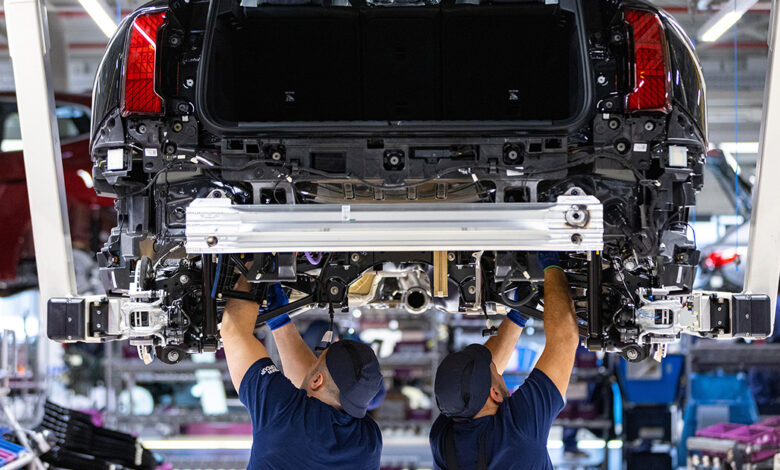
CEO Milan Nedeljkovic, who assumed the role in May, is leading this restructuring after issuing a major profit warning last month. The voluntary redundancy program is designed to boost profitability by 2028. The cuts will primarily affect staff in research, development, planning, and other corporate functions, while factory floor workers remain ineligible for the buyout scheme. Additionally, BMW plans to streamline its management ranks in the coming months as part of this broader effort to become leaner and more efficient.
The decision reflects a wider crisis within the German auto sector, which is under intense pressure from multiple fronts. The most significant driver is the steep decline in demand in China, BMW’s largest single market. Local manufacturers, led by BYD Co., have surged ahead in the electric vehicle segment, capturing market share that previously belonged to European brands. This competitive squeeze is compounded by a property crisis in China that has weighed on consumer spending. Furthermore, these same Chinese rivals are now expanding into Europe, further threatening BMW’s home market.
“The Chinese are also increasing their market share here,” said Stefan Bratzel, director of the Center of Automotive Management in Bergisch Gladbach. “The clear directive for BMW and its peers is to become leaner, more efficient and faster.”
BMW is not alone in its retreat. The broader German auto industry is slashing expenses in response to a confluence of challenges, including U.S. tariffs, high production costs in Europe, and the fallout from geopolitical conflicts. Volkswagen AG has been pushing to cut tens of thousands of workers and reduce capacity to stave off fast-moving competitors. Its Porsche unit recently announced a deal with labor officials to eliminate 5,000 jobs by 2035. Mercedes-Benz has also engaged in recent workforce reductions, illustrating a sector-wide pattern of retrenchment.
The contrast in how these companies are handling their restructuring is notable. BMW’s deal with worker groups was struck with relatively little public noise, a stark difference from the conflict at Volkswagen, where CEO Oliver Blume is facing months of difficult negotiations. The Volkswagen supervisory board, where unionists hold significant power, recently pushed back against proposals for as many as 100,000 job cuts and the closure of four German factories. At BMW, however, the process has been more consensual, with the collective bargaining agreements remaining intact.
Horst Ott, an IG Metall official in Bavaria and a BMW supervisory board member, stated that the carmaker is “responding to the collapsing market in China while simultaneously working to strengthen the competitiveness of its German sites.” BMW employed 87,436 people in Germany at the end of last year, accounting for more than half of its total global headcount. Even before this latest round of cuts, the German workforce had already declined by 2.3% from the prior year, according to the company’s 2025 annual report.

Financial markets have reacted with cautious optimism, with BMW shares rising as much as 1.9% in Frankfurt on the news. However, the stock remains down more than a third this year, reflecting the ongoing uncertainty surrounding the company’s outlook. Nedeljkovic, previously the head of production at BMW, is betting that the company’s recent multi-billion euro investment in its Neue Klasse platform of vehicles will help it compete against Tesla Inc. and Chinese carmakers in the future.
As the industry pivots, the focus shifts to execution. The next critical moment will be the staff-wide meeting in Germany on July 29, where Nedeljkovic and works council leaders are set to formally announce the voluntary reduction program. For the thousands of employees in corporate and R&D roles, the coming months will determine whether they accept the severance packages or remain with a company that is fundamentally reshaping its cost structure to survive an increasingly competitive global market.