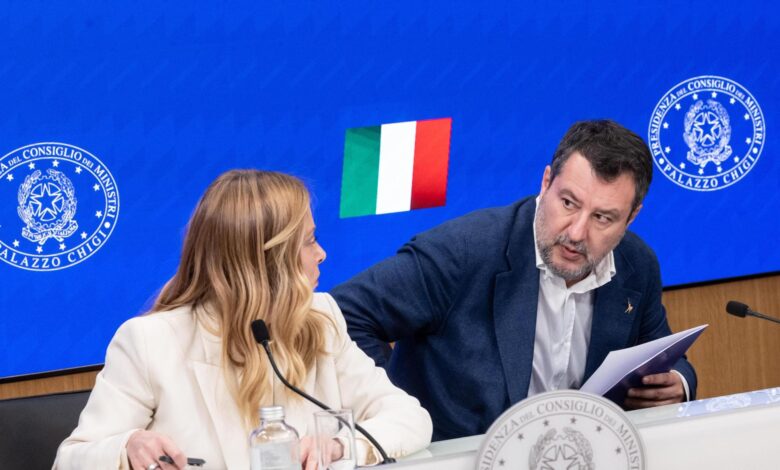
The Prime Minister framed the decision not as a matter of altruism, but of national interest. “I do not support Ukraine simply for the sake of the Ukrainians. I do it for Italy,” Meloni told Vespa. She argued that an international scenario where the “law of the militarily strongest is the only one that prevails” is fundamentally contrary to Italy’s interests. Meloni emphasized, “This is not a political opinion; it is a fact.” By anchoring the policy to strategic necessity rather than moral obligation, she sought to insulate the decision from the shifting tides of domestic public opinion, which she acknowledged are punishing her politically.
Despite Meloni’s firmness, the Italian ruling coalition is visibly fractured on this issue. Deputy Premier and League leader Matteo Salvini has repeatedly expressed skepticism about supporting Kyiv. Following his re-election as leader of the right-wing League party on Sunday, Salvini insisted that the current approach has had severe economic repercussions for the domestic sector. “The sanctions have only brought Italian businesses to their knees,” Salvini stated. His comments highlight a growing disconnect between the government’s foreign policy objectives and the immediate economic realities faced by Italian industry, suggesting that the cost of maintaining sanctions and support for Ukraine is being felt acutely in the business community.
The conflict within the cabinet extends beyond rhetoric to active policy planning. While Salvini signaled an intention to stop Italy’s economic and military support for Ukraine, his fellow Deputy Premier and Foreign Minister, Antonio Tajani, of Forza Italia, responded by confirming that another package of aid for Ukraine is currently “in the pipeline.” This direct contradiction in strategy among the top leaders of the coalition underscores the fragility of the alliance’s consensus on foreign policy. Tajani’s announcement suggests that the government is proceeding with further commitments despite the vocal opposition from Salvini and the acknowledged political cost cited by Meloni.
The divergence between the Prime Minister’s strategic framing and the Deputy Premier’s economic concerns reflects a broader tension in European politics regarding the sustainability of sanctions and aid packages. Meloni’s argument relies on the long-term stability of an international order based on law, whereas Salvini’s position focuses on the short-term tangible impact on Italian commerce. The phrase “brought Italian businesses to their knees” indicates a perception that the economic burden has exceeded a manageable threshold for domestic firms, potentially influencing political sentiment in ways that threaten the coalition’s cohesion.
As the excerpts from Vespa’s interview circulate, the political calculus for Meloni becomes clearer: she is willing to absorb electoral dissatisfaction to maintain a consistent foreign policy line. However, the operational reality of the government is complicated by the fact that the very ministers responsible for executing this policy are publicly questioning its viability. The confirmation of a new aid package by Tajani, juxtaposed with Salvini’s pledge to halt such support, sets the stage for significant internal governance challenges. The coming weeks will likely see a test of whether the Prime Minister can override the economic objections of her coalition partners or if the pressure from Italian businesses, as described by Salvini, will force a reassessment of Italy’s contribution to the war effort.
The situation leaves Italian businesses in a precarious position, caught between a government that is committed to international solidarity and a political faction that argues this solidarity is economically destructive. Until the coalition resolves this fundamental disagreement, the “political price” Meloni mentions may translate into concrete policy instability, affecting not only Italy’s diplomatic standing but also the predictability of its economic environment for domestic and foreign investors alike.