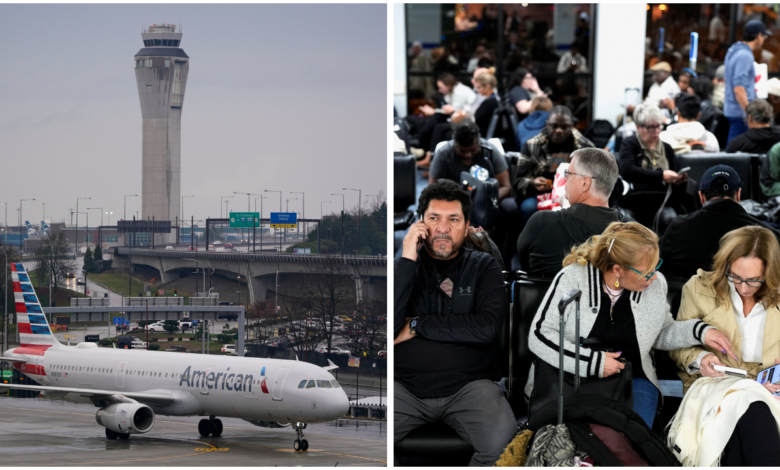
The ground stop was imposed “due to extraordinary circumstances and for reasons of safety,” according to an FAA notice. Transportation Secretary Sean Duffy identified the root cause as a communication issue impacting all Air Route Traffic Control Centers. In a post on X, Duffy noted that FAA technicians were investigating the issue and promised immediate updates. He later described the failure as a “legacy network problem,” stating, “We have old switches, old routers, we use 1980s old copper lines. We use an old system.”
The immediate impact on the aviation sector was severe. According to the aviation analytics company Cirium, at least 827 flights were diverted in the early stages of the disruption. By the time the ground stop was lifted, the scale of the disruption had expanded significantly. The FlightAware tracker reported that over 4,500 flights were canceled on Friday, with approximately 700 cancellations expected for Saturday. Additionally, more than 10,000 flights within, into, or out of the United States faced delays. At the peak of the ground stop, with some 11,000 flights scheduled to depart U.S. airports after 4 p.m. local time, further cancellations were anticipated.
Passengers experienced the immediate consequences of the halt. Jeff Dubner, a Washington attorney, described the moment his Alaska Airlines flight from Los Angeles came to a halt while taxiing to the runway. “It’s frustrating. This certainly sounds like it’s going to be more than the usual run-of-the-mill delay. I look forward to finding out why,” Dubner said. Thousands of travelers across various airports faced delays and cancellations, upending travel plans through at least late Friday night.
Despite the operational chaos, officials consistently downplayed the possibility of a malicious motive. Homeland Security Secretary Markwayne Mullin told reporters at the White House that there was no indication the communications breakdown resulted from a cyberattack or artificial intelligence. “It’s just a telecommunications outage as of right now,” Mullin stated. He assured the public that “everybody’s safe” and that there was “no reason to be concerned about your loved ones if they’re flying.” The FAA reinforced this message, noting that every flight had been accounted for and that the halt was taken “out of abundance of caution.”
The disruption extended beyond U.S. borders, affecting international logistics and neighboring aviation authorities. The European Organisation for the Safety of Air Navigation, Eurocontrol, announced that all flights departing for U.S. airports from its 42 member states were suspended following a request from the FAA to address technical issues. In Canada, the air navigation service provider, NAV Canada, stated it was closely monitoring the situation and implemented traffic management measures at major hubs, including Toronto Pearson, Montreal-Trudeau, Calgary, and Vancouver, to safely manage traffic volumes. Toronto Pearson Airport advised travelers to expect delays and check with their airlines, noting that flights between Toronto and the U.S. were impacted.
Not all regions were equally affected. Alaska Airlines reported that some flights within Alaska and Hawaii were not impacted by the ground stop. For international flights, the FAA indicated they would be handled on a case-by-case basis, with some departures observed in the evening after the restrictions began to ease.

The incident highlights vulnerabilities in the U.S. aviation infrastructure, specifically the reliance on aging telecommunications equipment. While the FAA has lifted the ground stop, the investigation into the cause of the failure continues. The reliance on “1980s old copper lines” and legacy systems, as described by Secretary Duffy, suggests that such disruptions may not be an isolated event but a symptom of broader infrastructure challenges. For now, the focus shifts to managing the residual effects of the outage, including the backlog of delayed flights and the economic and logistical strain on the airline industry.
As the skies reopen, the immediate crisis has passed, but the underlying questions regarding the resilience of the nation’s air traffic control communications remain. The FAA’s swift action to ground all traffic prioritized safety over operational continuity, a decision that, while disruptive, prevented potential conflicts in the air during the communication blackout. The next steps involve a full forensic analysis of the legacy network failure to determine if systemic upgrades are necessary to prevent a recurrence of such a significant halt to American aviation.