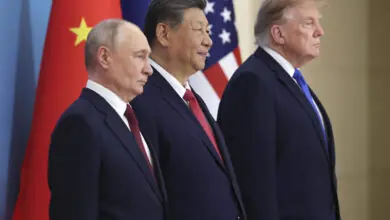
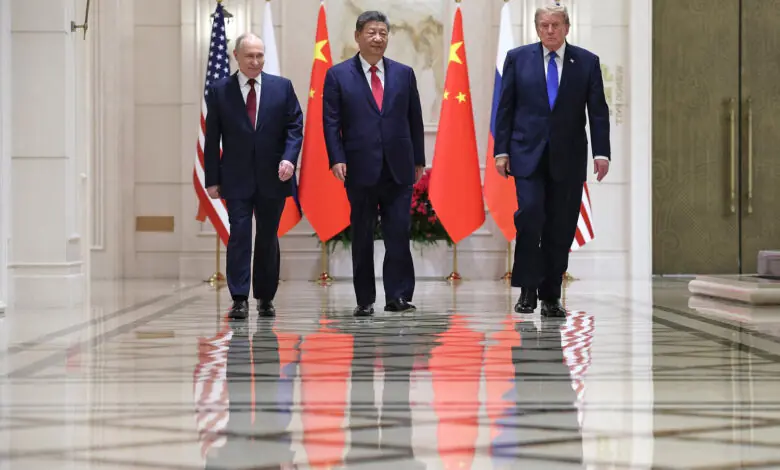
The summit, which concluded two days of bilateral negotiations, was framed by all three leaders as historic. President Trump described the gathering as making history, while President Xi highlighted its “pioneering significance.” Putin characterized the exchange as “entirely open and candid,” stating that the leaders discussed international security issues including the war in Ukraine, nuclear risks, maritime security, and the role of international institutions. However, the meeting produced only a four-point joint declaration on “peace,” with no progress reported on critical issues such as nuclear proliferation, trade disputes, or critical minerals supply chains.
The most visible moment of the summit was President Trump’s public affection toward Putin. Amidst an ongoing full-scale war in Ukraine that has claimed hundreds of thousands of lives and is approaching its fifth anniversary, Trump embraced the Russian leader, referring to him as “my friend.” This gesture stood in stark contrast to the Western strategy of isolating Putin since the invasion began. While Putin spoke of a shared “responsibility for maintaining international peace” and strengthening international law, his military was simultaneously conducting a bombing campaign against civilian infrastructure in Ukraine. On the same day the leaders met in Shenzhen, drones targeted central Kyiv, aiming to leave millions without power and water.

The diplomatic friction was further exacerbated by President Trump’s comments regarding the International Criminal Court (ICC). Before cameras, Trump attacked the ICC as being “out of control,” a stance that aligned with the final joint declaration’s criticism of the tribunal for abusing its power. This was a significant reversal, as the United States had previously endorsed the ICC’s 2023 arrest warrant for Putin on war crimes charges. Jonathan Eyal, associate director at the London-based Royal United Service Institute, noted that the only substantial outcome of the summit was the “rejection of international law and institutions.” While Trump’s comments may have been intended to defend Israeli Prime Minister Benjamin Netanyahu, who is also facing ICC indictments, analysts suggest the move ultimately benefited Putin by shielding him from international legal accountability.
The absence of concrete results has drawn sharp criticism from European allies. Poland’s Prime Minister Donald Tusk responded to the summit by posting on social media, “God protect us from such friends.” The meeting evoked comparisons to the 1945 Yalta Conference, where Franklin D. Roosevelt, Winston Churchill, and Joseph Stalin divided Europe, but with a critical difference: this time, there were no concrete territorial or political divisions announced. Instead, the event sent a signal that the U.S. president was willing to stand alongside authoritarian leaders without addressing human rights, press freedoms, or political prisoners.
Observators suggest the summit’s timing and nature may reflect domestic political pressures in Washington. President Trump, recently weakened by midterm election results and frustrated by conflicts he promised to end quickly, may have sought to bolster his image through high-profile diplomatic engagement. He had pledged during his 2024 campaign to solve the Ukraine war in a single day and to quickly end the conflict with Iran, a promise complicated by the recent U.S.-Israeli attacks on Iran. Boris Bondarev, a former Russian diplomat who resigned in 2022 in protest, told ABC News that the event was “all about appearances,” confirming Putin’s long-standing desire to be treated as a “full member of the club” of great powers.
Despite the lack of agreements, the meeting was not devoid of immediate diplomatic activity. Upon leaving China, President Trump joined a phone call with his envoys, Steve Witkoff and Jared Kushner, who were in Berlin meeting with Ukrainian officials and an eight-member European negotiating team. These teams are working on security guarantees and an economic recovery plan for Ukraine. The trilateral summit, therefore, exists in parallel with ongoing multilateral efforts to resolve the conflict, creating a complex diplomatic landscape where symbolic gestures in Asia run counter to the practical negotiations in Europe.
The significance of the Shenzhen meeting lies less in its content than in its signal. By granting Putin the platform and the “friendship” he sought, the summit validated Russia’s status as a peer to the U.S. and China, regardless of its adherence to international norms. For Europe, the challenge remains to navigate a world where the three largest nuclear powers have aligned publicly, potentially at the expense of the international legal order and the security guarantees sought by Ukraine. The next phase of diplomacy will likely test whether this new trilateral dynamic can coexist with the existing multilateral frameworks, or whether it marks a definitive shift in global governance.