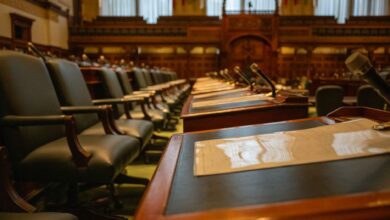
The procedural significance of the speakership cannot be overstated. The speaker of the parliament controls the agenda, manages debate, and holds significant influence over legislative processes. By securing this role, the AfD moves from a position of opposition to one of institutional leverage. One month after winning 44% of the regional vote in the state elections, the party has cemented its status as the dominant political force in Saxony-Anhalt. The chamber currently consists of 111 seats, with the AfD holding 39, a majority that was not enough to elect the speaker without external support, given the composition of the other parties in the room.
The election of the deputy speakers further illustrated the complex arithmetic of the new parliament. Hans-Thomas Tillschneider, a 48-year-old AfD veteran who joined the party in 2013, was elected as one of the three deputy speakers. The vote was conducted by secret ballot, with Tillschneider receiving 44 votes in favor and 38 against, with no abstentions. The fact that Tillschneider received more votes than the AfD’s total seat count of 39 confirms that members of other parliamentary groups voted for him, a clear indicator of the cross-party maneuvering that facilitated the AfD’s ascent to the speakership.
This development occurs against a backdrop of broader political instability in Germany. The AfD’s success in Saxony-Anhalt is viewed as a direct threat to the traditional center-right CDU and the current federal ruling coalition. The party’s ability to attract votes from both the right and the far-left fragments the political spectrum, making traditional coalition building increasingly difficult. For the federal government, the state’s new configuration poses a challenge in maintaining political cohesion and policy consistency, particularly on issues where the AfD’s platform diverges sharply from mainstream European and German norms.
German Foreign Minister Annalena Baerbock has recently warned that the climate crisis could serve as a fuel for extremism, suggesting that economic and environmental anxieties are driving voters toward populist parties. While the AfD’s platform focuses heavily on immigration and national identity, the support of the far-left BSW suggests that economic grievances and a rejection of the current political establishment are potent motivators for voters in eastern Germany. The BSW, which advocates for a return to more traditional industrial policies and a critical stance on European integration, found common ground with the AfD on procedural matters, even as their broader political goals remain distinct.
The implications for Saxony-Anhalt are immediate. With the AfD at the helm of the parliamentary procedures, the party can influence the timing and scope of debates, potentially slowing down or blocking legislation that does not align with its priorities. The remaining two deputy speakerships are still to be decided, with elections expected to follow in the coming sessions. These future appointments will further define the balance of power within the chamber and reveal whether the fragile alliance between the AfD and the far-left will persist or if other configurations will emerge.
For the German federal government, the situation in Saxony-Anhalt serves as a warning sign. The traditional political order, built on the post-war consensus that excluded far-right parties from positions of procedural power, has been breached. The next political development to watch will be how the federal parties, particularly the CDU, respond to this shift. Whether they seek to contain the AfD’s influence through strict procedural rules or attempt to form new coalitions that exclude both the AfD and the BSW will determine the stability of German governance in the coming months. The election of Tobias Rausch to the speakership is not merely a local event; it is a signal of a deeper realignment in German politics that challenges the institutions and norms established in the post-war era.
As the parliament in Magdeburg moves forward with its legislative agenda, the focus will remain on how the AfD exercises its new procedural powers. The absence of a traditional opposition bloc capable of checking the AfD’s influence, combined with the fragmented support from the far-left, creates a political environment where the status quo is under constant pressure. The next few weeks will reveal whether this new configuration leads to a functional government or to a stalemate that forces early elections or further political realignment.