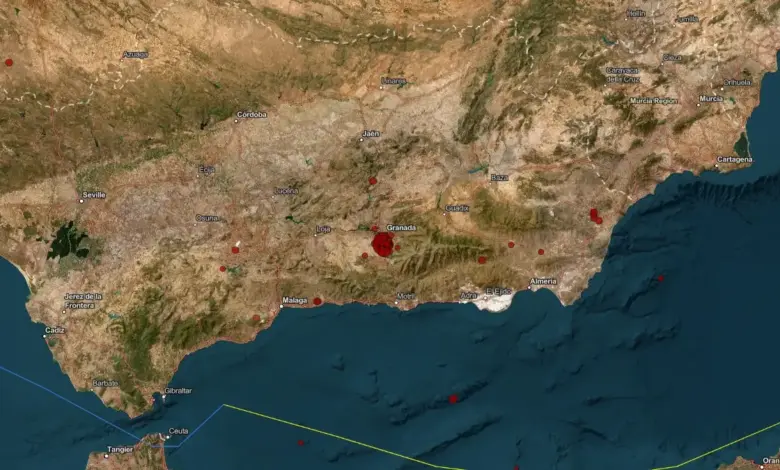
The seismic activity has been concentrated in the municipalities of Alhendín, Gójar, and La Zubia, located between 2 and 12 kilometers south of the city center. According to the Spanish Geological and Mining Institute (IGN), the majority of the 621 recorded events between August 14 and August 19 were of low magnitude, below M2. However, ten earthquakes reached magnitude 3 or greater, with the two strongest registering at magnitude 4.8. The first of these major events occurred at 1:04 a.m. on August 15, followed by the second on August 18. The shallow nature of the sequence, with hypocenters located at depths below 10 kilometers, significantly increased the intensity of the shaking experienced near the epicentral area, reaching intensity V–VI on the EMS-98 scale.
In the hours following the August 18 quake, a swarm of aftershocks continued to rattle the area. Three additional strong tremors, measuring M3.9, M4.2, and M4.0, occurred within a two-hour window, located south of Churriana de la Vega, north of Alhendín, and northeast of Gójar, respectively. This repeated shaking prompted immediate emergency responses, leading to the evacuation of approximately 600 residents from six apartment blocks containing 371 dwellings in Las Gabias after damage was identified. Technical teams have since inspected 580 buildings and properties across the affected zone. Of these, 459 were classified as “green” with no damage, 105 as “yellow” with minor damage, and 14 as “red,” requiring safety measures before normal occupancy could resume. No buildings were deemed to require demolition at this stage.
Impact on Infrastructure and Historic Sites
The seismic episode has caused widespread disruption to public services and cultural heritage sites. The Alhambra, a UNESCO World Heritage site, activated its earthquake protocols, evacuating parts of the complex and closing to visitors while specialists assessed the structure. Officials reported that no significant structural damage had been identified, though minor cracks appeared in some decorative plasterwork, particularly in areas subject to more recent interventions. The monument largely reopened by August 20, although visitor routes through the Nasrid Palaces remain modified to facilitate rapid evacuation if necessary. The Alcazaba and some associated monuments remain closed while inspections continue.
Emergency response centers have been overwhelmed with reports of the aftermath. The 1-1-2 Andalucía emergency coordination center received over 5,500 calls related to the seismic episode by midday on August 19. Reported incidents included falling building material, water leaks, broken pipes, people trapped in elevators, and anxiety-related episodes. In total, 14 medical attendances were recorded during the stronger activity on August 18, involving cases of anxiety, dizziness, and minor trauma. The Granada Provincial Council also evacuated and relocated all 77 residents of the Reina Sofía Psychopedagogical Center after damage was found at the facility, transferring them to other care centers in the province.
Local authorities have raised the emergency response level for the city, allowing for the deployment of additional resources as the sequence continues. While magnitude 4.8 events are considered relatively modest in global terms, their shallow depth and proximity to populated areas can cause intense surface shaking and damage vulnerable structures. This scenario recalls the 2011 Lorca earthquake, a shallow magnitude 5.1 event that killed nine people and caused widespread damage to historic buildings in southeastern Spain. As inspections continue and the Alhambra adjusts its visitor routes, the focus remains on monitoring the ongoing seismic activity and ensuring the safety of residents in the affected southern suburbs of Granada.