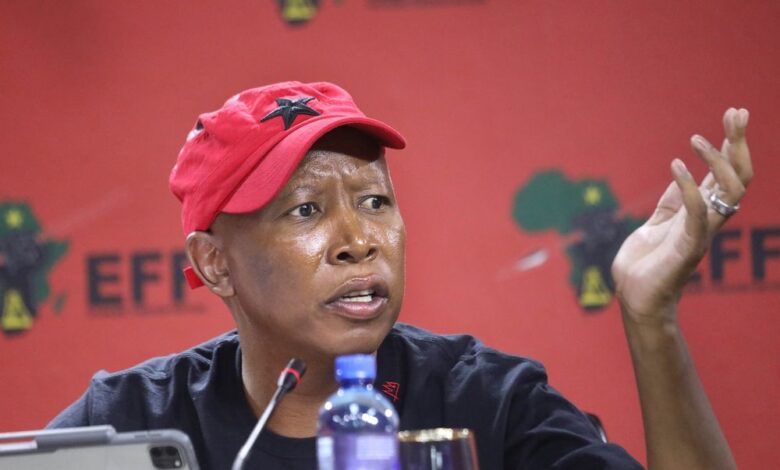
The application, filed in the Johannesburg High Court, marks a significant escalation in tensions between the two parties as they navigate the complex political landscape of potential coalition negotiations. The dispute stems from an interview Zille gave on the eNCA news channel on 8 November 2026, in which she discussed her relationship with ActionSA leader Herman Mashaba. During the broadcast, Zille alleged that Mashaba, who served as mayor of the City of Johannesburg under the DA, effectively allowed Malema to dictate major municipal decisions.
In the interview, Zille claimed that Malema “captured City Power” and influenced key procurement processes, including a fleet tender worth billions of rands, for the benefit of the EFF and Malema’s “front companies.” She further alleged that Mashaba appointed Shadrack Sibiya, a former deputy national police commissioner, as head of the city’s anti-corruption unit at Malema’s instruction. Zille stated that when the DA opposed the appointment, Mashaba reportedly replied, “that is the price we pay to stay in power.” She characterized Mashaba’s tenure as one where he remained in power by relying on Malema’s support, despite having a “problem” with Zille herself.
Following the broadcast, Malema’s legal team, England Slabbert Attorneys Inc., issued a formal letter of demand on Monday. The lawyers argued that Zille’s statements were defamatory, presented as fact without basis, and calculated to impugn Malema’s integrity. They alleged that the remarks portrayed the EFF leader as dishonest, corrupt, and manipulative, abusing political power for personal gain. The letter demanded that Zille retract the statements, issue a public apology, and sign a written undertaking not to repeat the allegations.
Zille refused to comply with the demand. In response, her legal team issued a brief statement: “See you in court.” This refusal led Malema to apply for an urgent interim interdict to stop her from repeating the claims.
During the court hearing, Advocate Mfesana Ka-Siboto, representing Malema, argued that his client had established a prima facie right to an interdict. He contended that Zille deliberately deployed these allegations to “contaminate” the ongoing coalition government negotiations. “What is currently happening are negotiations around the coalition government. Ms Zille deliberately deployed a lie to contaminate that process,” Ka-Siboto told the court. He maintained that the statements infringed upon Malema’s constitutional right to dignity, regardless of whether Zille subjectively believed them to be true. Ka-Siboto further argued that Zille’s claims were based on “hearsay evidence” from historical media reports rather than substantiated facts.
Conversely, Zille’s legal team opposed the application, arguing that Malema was attempting to use the courts to gag her from discussing what they described as improper influence during a critical period of municipal governance. They contended that the allegations touched upon matters of significant public interest and that an interdict would restrict legitimate political discourse.
The legal proceedings come at a sensitive time for South African politics. While Malema has previously ruled out forming coalitions with the DA and the Freedom Front Plus (FF+), citing ideological incompatibilities, the current national political climate involves intricate coalition talks between various parties to form a stable government. The EFF has also indicated a willingness to engage with white Afrikaner farmers to address misunderstandings, signaling a broader strategy of outreach beyond its traditional base.

However, the dispute with Zille highlights the fragility of political trust in South Africa’s multi-party system. The EFF’s insistence on the interdict suggests that it views the allegations not merely as partisan criticism, but as a direct threat to its leadership’s reputation and negotiating position. If successful, the interdict would legally bind Zille from repeating specific statements, a move that critics argue could set a precedent for limiting political speech in the lead-up to future electoral cycles or coalition agreements.
The court must now determine whether the balance of convenience favors granting the interdict, weighing Malema’s right to dignity against Zille’s right to freedom of expression and the public’s right to information about past municipal governance. The outcome of this case will likely have implications for how political leaders address allegations of corruption and capture in the public sphere, particularly during periods of intense coalition bargaining.
The Johannesburg High Court is expected to make a ruling on the urgency of the application in the coming days, with the final judgment on the interdict potentially following a full trial if the matter is not settled.