
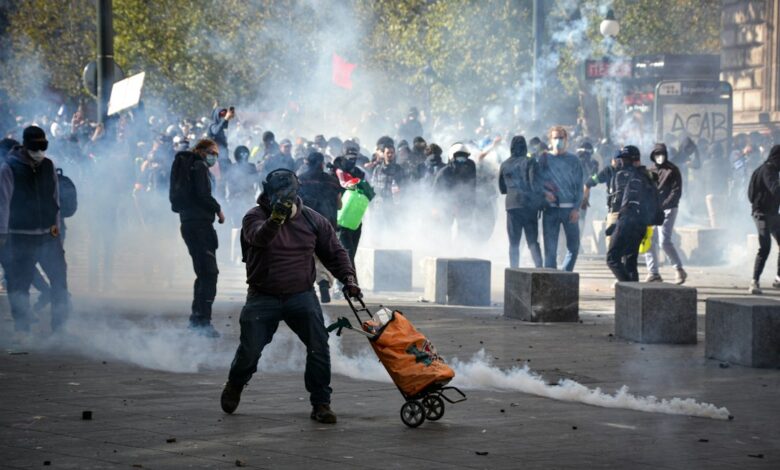
The political shift is significant. What began in Chile nearly two months prior as a specific opposition to a metro fare increase has widened into a general uprising against endemic economic inequality, the cost of healthcare and education, and the perceived brutality of state security forces. President Sebastián Piñera, in a televised address, declared a state of emergency in Santiago, a measure permitted under Chile’s dictatorship-era constitution. The order, which can last for 15 days, grants the government additional powers to restrict citizens’ freedom of movement and assembly. Consequently, soldiers have returned to the streets for the first time since an earthquake devastated parts of the country in 2010. Piñera stated that the aim was “to ensure public order and the safety of public and private property,” asserting that there would be “no room for violence in a country with the rule of law at its core.”
However, the government’s response has been complicated by the parallel application of the State Security Law, confirmed by Interior Minister Andrés Chadwick. This legislation, used most frequently in relation to the Mapuche conflict since Chile’s return to democracy in 1990, allows for special powers of prosecution and heavy sentences of up to 20 years for those found guilty of inhibiting or damaging public services. Critics argue that this legal framework, combined with the state of emergency, prioritizes the protection of property and state authority over the safety of protesters. Patricia Muñoz, Chile’s ombudsperson for the rights of minors, expressed concern for young people involved in violent confrontations, noting that the information provided by authorities is “one-sided.”
The unrest in Chile is not an isolated incident but part of a synchronized wave of dissent that has spread to at least nine other countries in the region. In Colombia, the “cacerolazo” echoed across the country on Sundays, joining a unified demonstration dubbed the “Latin American Cacerolazo.” In Medellín, thousands gathered, including 27-year-old university student Ana Maria Grajales, who banged a tin can with a dented spoon in the city center. For Grajales, the act was a declaration that “we Latinos are tired of being walked all over.” She cited the lack of opportunities for young people and the persistence of the same political class as primary drivers of the discontent.
In Colombia, the protests have stretched on for 11 days, spurred by a variety of issues including rumored economic reforms, the killings of indigenous and social leaders, corruption, and the flailing peace accords. President Iván Duque’s government has attempted to manage the crisis through minor concessions, such as including provisions for poorer Colombians in a tax bill and calling for a “national conversation.” However, analysts suggest these efforts have done little to appease protesters who feel the government interprets popular will on its own terms. Sergio Guzman, director of Colombia Risk Analysis, described the protests as symbolic of general dissatisfaction with the status quo, noting that communities are often not taken into account on major decisions that affect them.
The political significance of this regional synchronization lies in the shared grievances that transcend national borders. From the economic crisis in Argentina to recent protests in Mexico, Ecuador, Peru, and Bolivia, the underlying themes remain consistent: a disconnect between the state and the populace, and a demand for structural change rather than incremental reform. In Chile, psychiatrist and writer Marco Antonio de la Parra noted that the targets of the protests—transport and energy—are deeply symbolic, representing the success of the state model that many citizens now reject. He observed that over the past decade, the Chilean state has lost touch with these fundamental problems.
The role of security forces in exacerbating tensions cannot be overlooked. In Chile, anger has been directed at the Carabineros national police force, an institution once highly respected but whose reputation has been eroded by corruption scandals and a reputation for brutality. The heavy-handed repression of protests has drawn international scrutiny and fueled further unrest. The entity controlling the Santiago Metro network has suspended service over the weekend, while the Chilean student federation has called for a nationwide strike for Monday, indicating that the mobilization is far from over.
What remains uncertain is whether the current wave of protests will lead to substantive policy changes or if the state’s reliance on legal and military measures will suppress the movement. In Colombia, negotiations between protest leaders and the Duque government have hit a snag, with the government’s approach viewed by many as insufficient. The “cacerolazo,” a tradition dating back to medieval “rough music” and adopted by revolutionaries in France and Algeria, has proven to be a potent tool for maintaining momentum. As the sounds of banging pots continue to echo across the continent, the central political question remains: whether the existing institutional frameworks can absorb this level of dissent or if the era of the current political order is ending. The next development will likely be determined by the outcome of the ongoing strikes in Chile and the progress, or lack thereof, in the national conversation in Colombia.



One Comment