
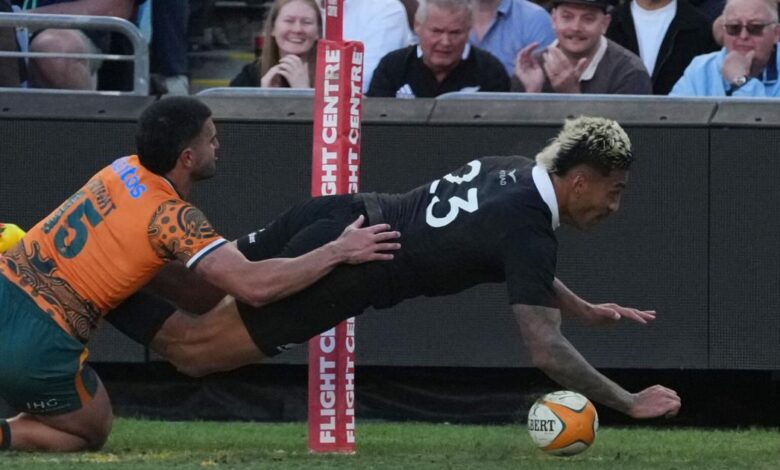
New Zealand has extended its Bledisloe Cup winning streak over Australia to 13 consecutive matches with a 43-21 victory in Sydney on Saturday. The result completes a 2-0 series sweep for the All Blacks, who had already secured the trophy the previous week with a 50-19 win in Auckland. For Australia, the defeat offers a stark reality check ahead of next year’s World Cup, marking a sharp reversal of momentum following early promise under new coach Les Kiss.
The narrative of the match was defined by New Zealand’s first-half dominance. After a frenetic but scoreless opening 12 minutes, the All Blacks unleashed a high-tempo, breadth-of-the-field attack that overwhelmed the Wallabies. New Zealand scored six tries in the opening 40 minutes, conceding only one to lead 36-7 at halftime. This performance mirrored the style New Zealand had attempted to impose during their recent tour of South Africa, where they ultimately lost the test series 3-1. In Sydney, however, the execution was flawless, with the All Blacks exploiting the Wallabies’ defensive errors and missed tackles with clinical precision.
Scrumhalf Cam Roigard conducted the All Blacks’ attack superbly, switching play left and right to twist the Australian defense. Damian McKenzie complemented this orchestration with short passes that created line breaks, while the support game operated with ruthless efficiency. Captain Codie Taylor, hooker Peter Lakai, and backrower Wallace Sititi were pivotal runners, and fullback Beauden Barrett provided a constant threat, inserting himself into the backline to score his second try by halftime. Lock Fabian Holland was a physical presence, registering 21 tackles in the first half alone.
Despite the scale of the deficit, the Wallabies showed resilience in the second half. Australia won the second period 14-7, scoring two tries to New Zealand’s one. This momentum shift was driven by gritty efforts from the backline, including a near-try by fly-half Declan Meredith, who was put through by impactful substitutes Angus Bell and Josh Canham. Meredith also orchestrated a counterattack following a short drop-out by Tom Wright. However, as Wallabies captain Harry Wilson noted, the response was “too little, too late.” “We had a terrible second half in the first game, and we had a terrible first half in this game,” Wilson said. “You can’t have that.”
The defeat raises significant concerns for Australia’s World Cup preparations. The loss in Sydney, combined with the previous week’s thrashing in Auckland, has silenced much of the early optimism surrounding Les Kiss’s tenure. The coach was blunt in his post-match assessment, labeling the first-half performance “unacceptable.” “There’s got to be a little bit more thinking about what it really means to actually turn up in that first half,” Kiss said. “It’s just not acceptable what was put out there.” He acknowledged that the team had to question their approach at halftime, noting that they “don’t accept 22-0 suddenly like that.”
New Zealand’s dominance was further highlighted by the statistical disparity. The All Blacks’ ability to advance the ball at will, aided by superior breakdown speed, spoiled most Wallaby attacking forays. Even when Australia created opportunities, such as a promising move off a lineout that almost saw them take the lead, execution failures—like a ball going to ground when Harry Potter and Tom Wright had clear space—were punished immediately by the All Blacks’ counter-attacks.
Injuries also played a role in the dynamics of the match. New Zealand lost Jordie Barrett to a calf injury before kickoff, and Quinn Tupaea left the field dazed after a head collision in the first minute. Joseph-Aukuso Suaalii, back at 13 after two Tests on the wing, was influential early on, but the All Blacks’ depth proved sufficient to maintain their intensity.
For Australia, the season ends on a somber note. The Wallabies, who last won the Bledisloe Cup in 2003, find themselves in reverse after a period of early promise. The question lingered in the stadium and in the media coverage: when will the Bledisloe Cup pain end? As the All Blacks celebrated their 24th consecutive year with the trophy, the focus for Australia shifts entirely to the upcoming World Cup, where the “golden pretenders” must now find a way to translate their second-half grit into consistent, match-length performances.